Physical Therapy for Dogs with Arthritis: What the Evidence Actually Supports
Medically reviewed by Jennifer Freeman, DVM, CVA — For general education — not a substitute for veterinary care.
Physical therapy will not undo arthritis, but done consistently it can change how a stiff dog moves through an ordinary Tuesday.
On this page
The first time I watched a dog work through a set of sit-to-stand exercises on a rubber mat, I was struck by how unglamorous it was. No machines humming, no dramatic before-and-after. Just a twelve-year-old dog rising and lowering, rising and lowering, while her owner counted reps out loud. That plainness is the point. Physical therapy for an arthritic dog is not a cure — it is a structure/function intervention, a way of asking a joint to keep doing its job a little longer, a little more comfortably.
What arthritis actually does to a joint, and why movement matters
Osteoarthritis in dogs is a slow erosion of cartilage and a shift in how the joint capsule handles load. As cartilage thins, the synovial fluid that normally cushions and lubricates the joint changes in composition, and the surrounding muscles — deprived of pain-free full range of motion — begin to atrophy. That muscle loss is often what owners notice first: a dog who used to leap onto the couch now hesitates, or takes the stairs one at a time instead of two.
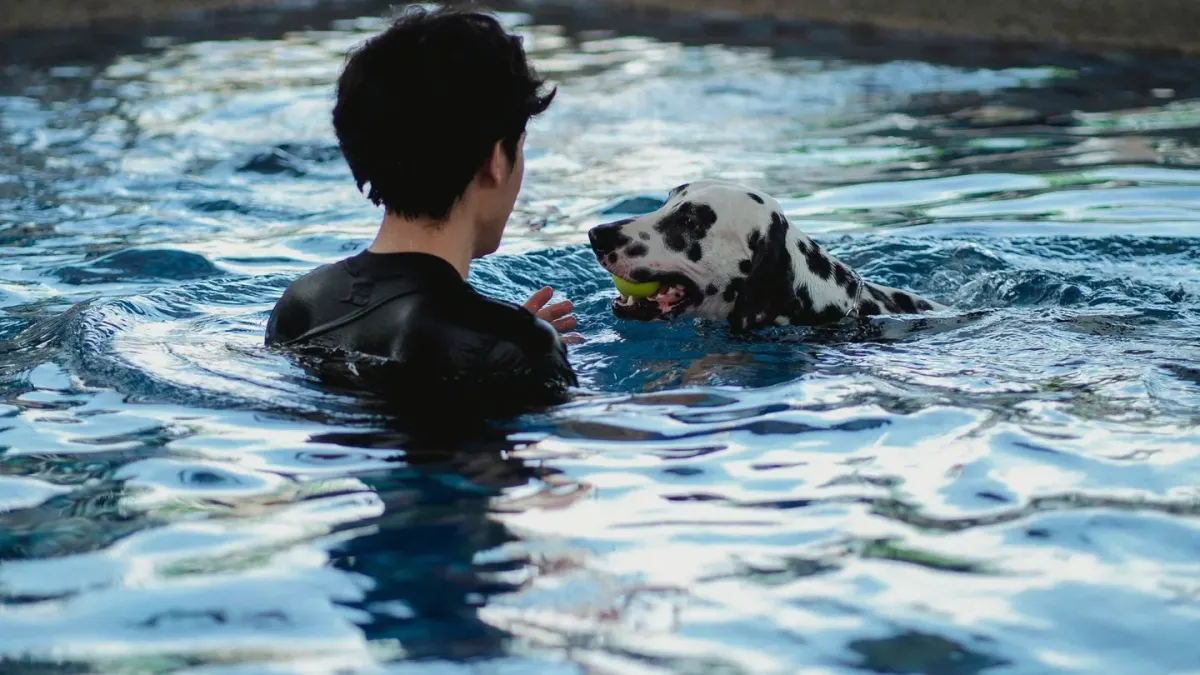
Physical therapy addresses the muscle side of that equation directly. Controlled exercise, whether it is underwater treadmill work, targeted stretching, or simple sit-to-stand drills, maintains the muscle mass that stabilizes an arthritic joint even when the cartilage itself cannot be restored. This is why a rehab-trained veterinarian will often talk less about the joint and more about the muscles around it — the quadriceps supporting a knee, the gluteal muscles supporting a hip. If you want the fuller picture of what that kind of program looks like day to day, our guide to at-home physical therapy for dogs walks through it.
A dog named Willa, and what six weeks actually looked like
One of the dogs I worked with in my mobile practice was Willa, a nine-year-old Australian Shepherd mix, about fifty-two pounds, whose owner had noticed her slowing down over a single winter. She’d stopped jumping into the car, and on cold mornings she’d stand at the bottom of the porch steps for a few seconds before committing to them. Her owner was weighing whether to start with a rehab referral or try a supplement first, mostly out of concern about cost and about whether Willa, who disliked being handled, would tolerate hands-on sessions at all.
We started conservatively: five minutes of controlled leash walking on flat ground twice a day, plus sit-to-stand sets before meals. By week three, the porch-step hesitation was gone. By week six, she was back to getting into the car on her own, though her owner still noticed stiffness after long naps. It was not dramatic. It was a pattern shift, and I’ve watched that particular pattern — slow onset, gradual response to structured movement — repeat often enough that I no longer expect anything faster.
Where nutrition fits, and where it doesn’t replace movement
A common question is whether joint supplements can substitute for the exercise itself. They can’t, and I say that as someone who food-first almost everything. What supplements can do is support the biochemical environment the joint is working in. Frontiers in Veterinary Science has published research indicating chondroitin supports healthy synovial fluid homeostasis — relevant because that fluid is exactly what thins as arthritis progresses. Separately, a review in the Journal of Veterinary Medical Science describes glucosamine HCl’s ability to prevent experimentally induced cartilage degradation in vitro, which is laboratory evidence, not a guarantee of the same effect in a living joint, but it is consistent with why glucosamine and chondroitin remain the most studied joint-support ingredients for dogs.
Green-lipped mussel has a slightly different evidence profile. A study published in Nutrients found that mussel-derived compounds alleviated paw swelling in rats and reduced serum levels of inflammatory markers including TNF-α and IL-17 — an inflammatory picture, not a mobility one, but it maps onto why some rehab plans pair movement work with an anti-inflammatory nutritional layer. None of this replaces the muscle-building work of a PT program; it may help support the joint environment that program is working within.
The honest caveat, and the counterargument worth taking seriously
The strongest counterargument to a structured PT program is a fair one: many dogs improve somewhat on rest, weight management, and an NSAID alone, without ever seeing a rehab specialist. That’s true, and for a dog with mild, early stiffness, that more conservative path is reasonable. Distinguishing ordinary aging stiffness from actual arthritis is its own skill, and our piece on arthritis vs. normal aging stiffness in dogs is a useful place to start before assuming PT is warranted at all.
Where I land, though, is that for a dog with a confirmed arthritis diagnosis and any visible muscle loss, physical therapy earns its place in the plan. The counterargument holds for mild cases; it holds less well once a joint has already lost supporting muscle, because that muscle does not come back on its own.
Meeting the dog in front of you
I think about Willa’s owner sometimes, and about a stouter, less cooperative case a year later — a fourteen-year-old Bulldog named Gus, sixty pounds, who could not tolerate the underwater treadmill at all and panicked in water. We built his program entirely around land-based sit-to-stands and short, frequent walks instead, adjusted to his breathing and his patience. That’s the part of this work I keep coming back to: meet each dog on its own turf, one at a time. There is no universal protocol, only a pattern of principles — controlled movement, muscle preservation, realistic pacing — applied differently depending on the dog in front of you.
If you’re building out a supplement layer alongside a PT plan, our guides on what actually belongs in a dog hip and joint supplement and how we test dog joint supplements go through what the label should say versus what it should mean.
Sources
- Chondroitin and Joint Health in Dogs — Frontiers in Veterinary Science
- Glucosamine HCl and Cartilage Degradation — Journal of Veterinary Medical Science
- Mussel-Derived Compounds and Inflammatory Markers — Nutrients