Signs of Osteochondritis Dissecans in a Young Labrador's Shoulder
Medically reviewed by Jade Tenberg, DVM — For general education — not a substitute for veterinary care.
A seven-month-old Lab who won't put weight on one front leg after a nap isn't being dramatic — that's the age and the joint OCD picks first.
On this page
The dog on my table that morning
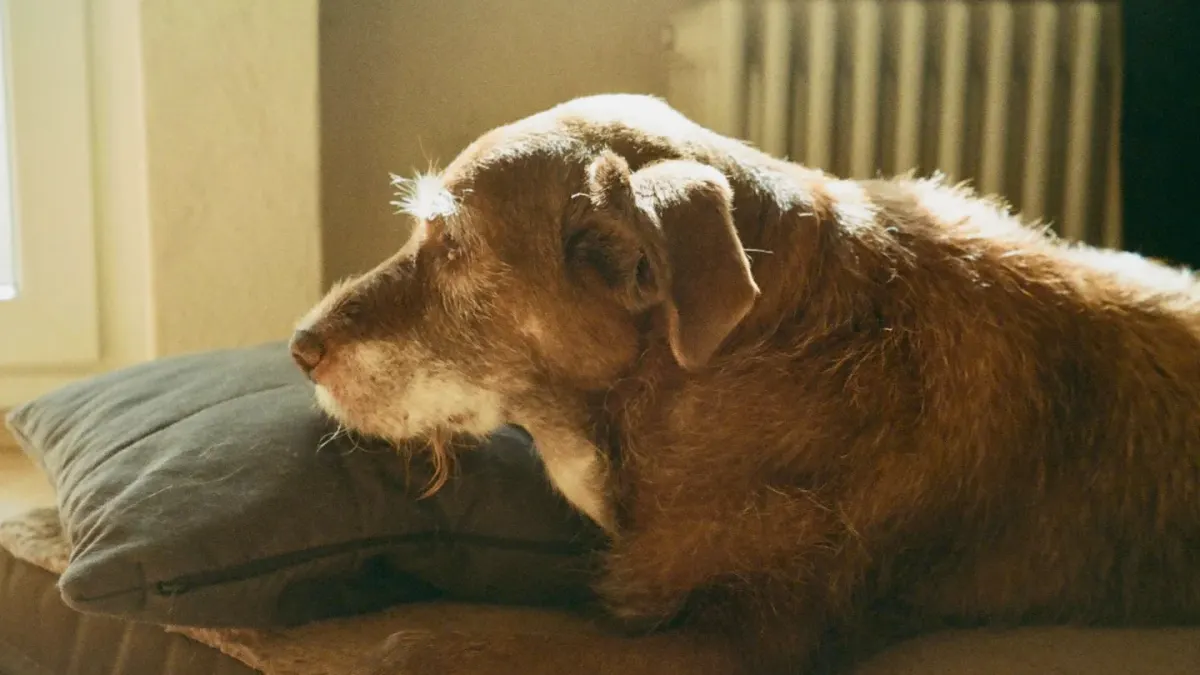
He was seven months old, sixty-one pounds already, and his owner carried him up the clinic steps because he wouldn’t take them himself. That’s the scene I keep coming back to when someone asks me what osteochondritis dissecans actually looks like in a young Labrador. The dog — I’ll call him Beau, because that was close enough to his real name — had been fine at the dog park on Saturday. By Sunday evening he was holding his right front leg slightly out from his body, elbow rotated in, and wouldn’t bear weight on it after he got up from a nap. No yelp, no obvious injury, no limping episode anyone could point to. Just a leg he suddenly wasn’t using right, worse after rest and better, oddly, after a slow lap around the yard. That pattern — stiff after lying down, looser once moving, then sore again after exercise — is the single most useful thing an owner can hand me before I ever touch a radiograph.
What OCD actually is, and why the shoulder specifically
Osteochondritis dissecans, or more precisely osteochondrosis progressing to a dissecans lesion, starts when cartilage in a growing joint fails to convert to bone the way it should. In the shoulder, that means the cartilage over the back of the humeral head thickens instead of ossifying normally, the deeper cells lose their blood supply and die, and a crack eventually opens between cartilage and bone. Sometimes a flap lifts free and floats in the joint. According to the American College of Veterinary Surgeons, this is a developmental disorder of medium and large, rapidly growing dogs, and it shows up specifically in the shoulder, elbow, stifle, and hock — the shoulder is the single most common site in Labradors. The same source notes males are affected more often than females, and that excessive nutrition, rapid growth rate, trauma, and heredity are all suspected contributors. None of that is something an owner did wrong by feeding a growing puppy; it’s closer to a manufacturing defect in the cartilage-to-bone conversion, and a fast-growing 60-pound seven-month-old is exactly the build where it turns up.
The signs I actually watch for
Forget “limping” as the whole checklist — it’s a start, not the finish line. What I look for, roughly in the order owners tend to notice it:
- A forelimb lameness that is worse after rest and improves, then worsens again, with exercise
- Reluctance to bear full weight on one front leg, sometimes shifting to a shortened, choppy stride
- Muscle loss over the shoulder on the affected side if it’s been going on more than a couple of weeks
- Pain when the shoulder is flexed and extended, sometimes a flinch or pulled-away leg on exam
- Occasionally holding the leg out or rotated rather than tucked normally under the body
The Merck Veterinary Manual puts the typical age window at four to eight months old for clinical signs to appear, which lines up with almost every shoulder OCD case I’ve worked up — it is very rare to see a first presentation in a dog past a year. If your Lab is two or three and just started limping, I’m looking somewhere else first, not at OCD.
A second dog, a different picture
I want to mention a dog I saw maybe a year after Beau, because the contrast matters. She was a nine-month-old female Lab, smaller frame, and her owners almost didn’t bring her in — she wasn’t holding the leg up or crying, just “off” on it some mornings, better by afternoon, worse again after a long fetch session. No muscle wasting yet. On exam she had a subtle but reproducible pain response on shoulder extension, nothing dramatic. Radiographs still showed a flattened, irregular contour on the caudal humeral head. I bring her up because OCD doesn’t always look like the textbook non-weight-bearing case. It can be quiet and intermittent for weeks before it becomes obvious, and by the time it’s obvious, more cartilage damage has usually happened. That’s the argument I’d make to any owner of a young, fast-growing Lab who’s on the fence about a workup: an intermittent morning stiffness in a seven- to nine-month-old large-breed puppy is worth an exam, not a wait-and-see.
What doesn’t confirm it, and what does
Radiographs remain how this gets diagnosed — a subchondral defect or, later, a visible cartilage flap or free joint mouse on the caudal humeral head is what a veterinarian is looking for on shoulder films, per the ACVS. Bloodwork won’t show OCD. A normal gait on a good day doesn’t rule it out either, especially early, when the lesion is small and the discomfort is intermittent. If your Lab puppy is showing the rest-then-worse pattern in a front leg between four and ten months old, that’s the profile that gets me reaching for films rather than just recommending rest and recheck.
Where joint support fits, and where it doesn’t
I want to be honest about the limits here, because this is where families get misled. Nothing you put in a bowl reverses an existing cartilage flap or fixes a subchondral defect — that’s a surgical and orthopedic conversation with your vet, not a supplement one. What joint ingredients like glucosamine and chondroitin are studied for is different: supporting the joint environment more broadly. Glucosamine HCl has been shown in review-level research to help prevent experimentally induced cartilage degradation in vitro, and chondroitin has research behind it for supporting healthy synovial fluid homeostasis. Neither of those statements is a claim that a supplement treats OCD — they’re structure and function research on cartilage and joint fluid, not a substitute for a diagnosis. If your dog has had OCD, whether managed surgically or conservatively, that’s exactly the kind of dog where a vet might discuss longer-term joint support once the acute lesion is addressed — for the joint’s general resilience going forward, not as treatment for the lesion itself. If you’re comparing what’s actually on different joint-chew labels, our checklist for scoring joint supplements walks through how we read a label and a Certificate of Analysis before recommending anything, and our piece on avocado-soy unsaponifiables versus glucosamine covers a related ingredient debate for dogs already past an acute joint issue.
The bottom line
If you have a Labrador puppy between roughly four and ten months old who is intermittently favoring a front leg — worse after rest, a little better once moving, then sore again after real exercise — that’s the age and the pattern where I want radiographs of the shoulder before anything else. It is common, it is largely hereditary rather than something you caused with diet or exercise, and catching it early genuinely changes the conversation with your surgeon. Everything else, including any joint supplement discussion, comes after that diagnosis is made, not instead of it.
Frequently asked questions
How old is a Labrador usually when osteochondritis dissecans of the shoulder shows up?
Clinical signs most often appear between four and eight months of age, according to the Merck Veterinary Manual, which fits with almost every shoulder OCD case I've personally worked up in young Labs.
Can diet or exercise cause shoulder OCD in a Labrador puppy?
The American College of Veterinary Surgeons notes heredity, rapid growth, excessive nutrition, and trauma are all suspected contributors, but shoulder OCD is understood as a developmental cartilage disorder rather than something caused outright by how a puppy was fed or exercised.
Will a joint supplement fix osteochondritis dissecans?
No. A supplement doesn't reverse an existing cartilage flap or bone defect — that's a diagnosis and treatment conversation with your veterinarian. Ingredients like glucosamine and chondroitin are studied for supporting cartilage and joint fluid more broadly, not for treating an active OCD lesion.
Sources
- Osteochondrosis of the Shoulder — American College of Veterinary Surgeons
- Osteochondrosis in Dogs — Merck Veterinary Manual