
The kitchen tile was cold, and the 9-year-old Labrador mix at 82 pounds stood for a moment with his hind feet planted, tail giving a slow wag while his owner held his coffee. For the first forty seconds he shifted weight, took two short steps, paused, then walked out to the yard with a looser stride by the third minute. The owner had been weighing whether to start a daily joint chew, add fish oil, or ask about prescription options, worried that doing everything at once would hide what was actually helping. Three weeks in on a consistent routine of label-directed nutrition, a five-minute warm-up leash walk, and a non-slip rug path, the morning pause had shortened from nearly a minute to about fifteen seconds.
My position, after watching this pattern layer over whole-patient care, is that morning hind-leg stiffness is best approached with layered modalities rather than a single ingredient. That means steady joint nutrition to help support normal joint structure, gentle movement to support circulation and mobility, weight and footing management, and a veterinary exam to rule out pain or neurologic causes. No chew alone replaces that stack.
What those first five minutes are telling you
Stiffness that is worst after rest and eases with slow movement often reflects joint comfort and synovial function.
Overnight the joints have not moved, muscles are cool, and arthritic or aging tissues may need time to warm up. I watch for how long the lag lasts, whether both back legs move short and choppy, whether the dog groans rising, and whether the gait normalizes within five to ten minutes. A log for seven mornings gives more useful information than any single morning.
Dogs that consistently improve with movement may be candidates for long-term joint support, while dogs that worsen with activity, drag toes, knuckle, tremble standing still, or cry out need prompt veterinary assessment. If you are seeing hind-leg trembling rather than simple stiffness, this explainer on why a dog’s back leg trembles while standing still may help you describe it to your veterinarian.
Stiffness that eases with movement points toward joint support.
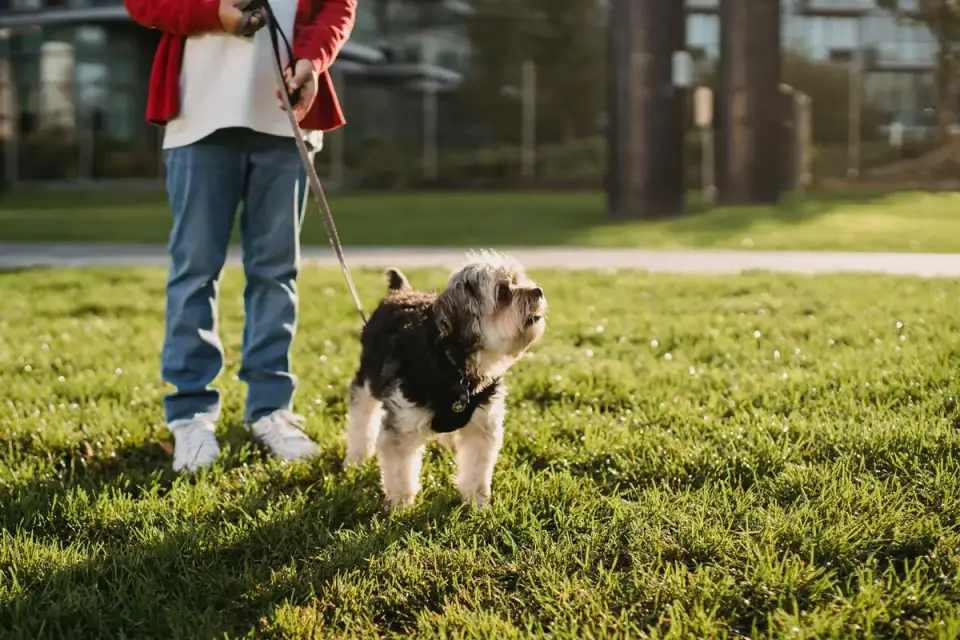
Why I start with layered support, not a single morning fix
In integrative practice I layer acupuncture thinking, movement, body weight, and nutrition with a teacher’s patience, because morning stiffness involves the joint capsule, surrounding muscle, and daily load together. A chew may help support one part of that system, while traction, weight, and a warm-up routine may help support the rest.
Practically that looks like a non-slip path from bed to door, a brief slow walk before breakfast rather than stairs or fetch, weight kept lean so hind legs carry less load, and any supplement given consistently with food as the label directs. For timing questions, owners often find this note on giving a joint chew with or without food useful for building a routine they can maintain.
The strongest counterargument I take seriously is that layering is too slow when a dog is clearly uncomfortable, and that a fast-acting pain medication prescribed by a veterinarian would be kinder. That concern is valid for moderate to severe pain, and medication has its place under veterinary direction. I still land on layered support as the starting frame for mild morning stiffness because it may help support mobility day after day without masking progression, and it keeps the veterinarian’s exam central rather than optional.
What the ingredient research actually says at the bench
When I buy a product off the shelf I read the guaranteed analysis, check for a lot number and a certificate of analysis, and weigh the dose against published research rather than marketing language. Glucosamine and chondroitin remain the foundation ingredients I compare first, with omega-3 sources and green-lipped mussel as secondary layers.
Chondroitin is described in work published in Frontiers in Veterinary Science as an ingredient that “supports healthy synovial fluid homeostasis,” which matters for that first-step comfort after lying all night. Glucosamine HCl has been reported in the Journal of Veterinary Medical Science to “prevent experimentally induced cartilage degradation in vitro,” a laboratory finding that may help support normal cartilage structure but does not prove pain relief in a pet dog. Green-lipped mussel contains omega-3 fatty acids and glycosaminoglycans studied for joint support, and research in Nutrients found that “BMO, GMO, and KO all alleviated paw swelling in rats and reduced serum levels of rheumatoid factor (RF), anti-cyclic citrullinated peptide (anti-CCP) antibody, and pro-inflammatory cytokines such as TNF-α and IL-17.”
Those are structure and laboratory observations, not promises of a pain-free morning. I favor may help support language and realistic expectations over cure-talk, and I adjust expectations by weight and life stage using label tiers rather than guesswork. Owners managing a large dog often need different label math than owners of a small dog, as outlined in this guide to how much glucosamine to give a 60 lb dog and in the discussion of adjusting dose as weight changes.
The 7-year-old pit mix at 58 pounds belonged to an owner who decided to double up two different joint chews plus a human fish-oil capsule, hoping faster mornings would follow. By day 10 the dog still rose slowly, and now had soft stool and had started refusing breakfast because the food bowl smelled strongly of oil. The owner had meant well, but the overlapping formulas made it impossible to know what was helping and the extra fat had unsettled digestion. We pared back to one complete label-directed formula given consistently, kept the morning walk to six slow minutes, and added a rug runner over the hallway hardwood. The stool normalized within four days, while the morning rise time only began to shorten in the third week.
When stiff mornings are not just joints
The 12-year-old miniature dachshund at 14 pounds looked stiff in the rear each morning, but the marker that changed my thinking was not stride length. By the second week of observation she began scuffing the tops of both hind nails on the patio concrete, leaving a pale worn edge the owner noticed on day 12. That toe-drag pattern points less toward simple joint stiffness and more toward possible neurologic involvement or hind-end weakness, where joint nutrition alone would miss the real issue. Senior small breeds, long-backed dogs, and dogs with prior disc disease deserve an early neurologic exam when stiffness includes weakness, crossing over, incontinence, or rapidly worsening mornings.
Layered support still has a role while awaiting that exam, with traction, ramps instead of jumps, and gentle assisted movement. It should not delay imaging, pain assessment, or referral when red flags appear.
If mornings improve only slightly after three to four consistent weeks, bring your log back to your veterinarian and ask what layer to change next. Would clearer notes on rise time, warm-up distance, and bad-surface slips help your veterinarian tailor support for your dog’s back legs.
Frequently asked questions
What can I give my dog at home for stiff back legs in the morning?
Many owners use a consistent joint-support routine with label-directed glucosamine and chondroitin nutrition, omega-3 support, a short warm-up walk, non-slip footing, and healthy weight, with veterinary guidance for pain or neurologic signs.
How long before a joint supplement may help support easier mornings?
Allow three to four consistent weeks while tracking rise time and warm-up distance, since joint nutrition is gradual support rather than immediate relief, and recheck with your veterinarian if there is no trend.
When should morning stiffness prompt a vet visit sooner?
Seek prompt care for crying out, inability to rise, worsening lameness, toe dragging or knuckling, trembling that persists, incontinence, or stiffness that worsens with movement rather than easing.
Sources
- Chondroitin and synovial fluid homeostasis — Frontiers in Veterinary Science
- Glucosamine and experimentally induced cartilage degradation — Journal of Veterinary Medical Science
- Marine oils, green-lipped mussel and paw swelling in rats — Nutrients