On this page
The first time I watched a nine-year-old Labrador named Otis go from refusing stairs to doing hind-limb figure-eights in a therapy pool, it took about six weeks. His owner had already tried a ramp, a weight-loss plan, and a joint chew before we got him into water. What changed wasn’t a supplement — it was load. On land, Otis’s arthritic hips had to carry all 72 pounds of him through every step. In chest-deep water, buoyancy took most of that weight off the joint while his muscles still had to work against resistance. That’s the whole argument for swimming in one sentence, and it’s worth unpacking before you drag a reluctant Beagle into a lake.
What buoyancy actually does to a joint
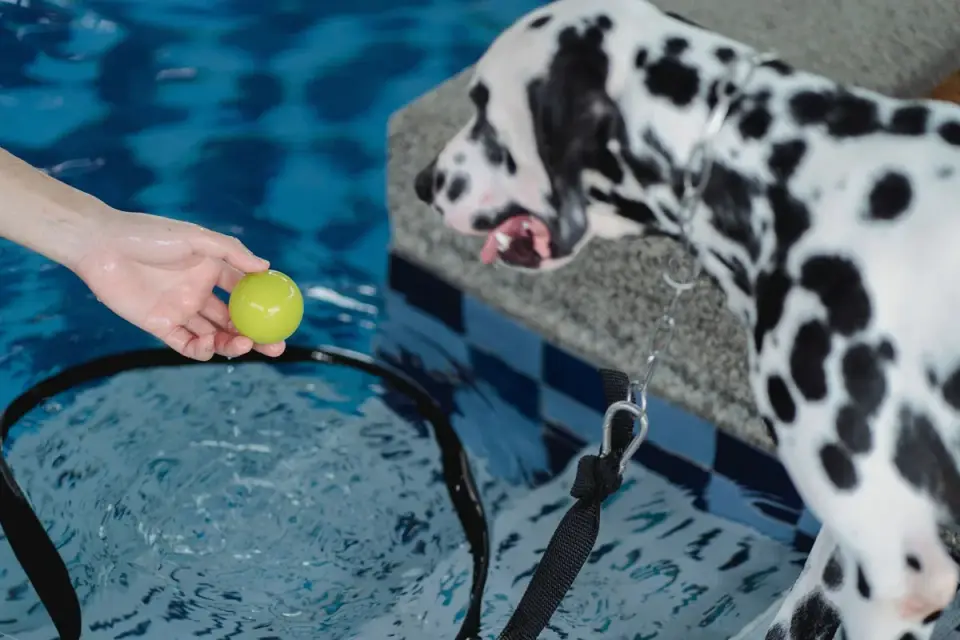
Water displaces roughly the same weight of the body that is submerged, so a dog standing chest-deep is bearing a fraction of its normal weight through its limbs. That’s not a marketing claim — it’s basic physics, and it’s why hydrotherapy is a staple of veterinary rehabilitation for dogs recovering from cruciate surgery, elbow dysplasia, or generalized osteoarthritis. The cartilage lining an arthritic joint is already compromised; every high-impact step on pavement adds a small dose of mechanical stress it can’t fully absorb. Swimming removes most of that stress while still asking the muscles around the joint to contract, which is a rare combination. Very few forms of exercise let you build or preserve muscle mass without also grinding on the joint underneath it.
Swimming is genuinely useful exercise for most dogs, and it’s one of the few forms of movement that builds muscle without loading an arthritic joint — but it isn’t a universal fix, and it isn’t a substitute for controlling inflammation at the tissue level.
Where swimming stops and cartilage biology starts
Here’s where I want to be precise, because owners often conflate “low-impact exercise” with “joint treatment,” and those are different things. Swimming can slow the rate at which a dog loses muscle mass and range of motion around an arthritic joint. It does not repair cartilage, and it does nothing to the biochemical processes happening inside the joint capsule — synovial fluid viscosity, cartilage matrix turnover, or the inflammatory cascade driving pain. Those are addressed, if at all, through medication, weight management, and in many cases nutraceutical support.
This is where I look at the ingredient literature the same way I’d read a supplement label off a shelf. Glucosamine and chondroitin are among the most studied joint support ingredients for dogs, and the mechanism matters: research published in the Journal of the Veterinary Medical Science has examined glucosamine HCl’s capacity to help prevent experimentally induced cartilage degradation in vitro. Separately, a study in Frontiers in Veterinary Science found chondroitin supports healthy synovial fluid homeostasis — the fluid that lubricates a joint and that swimming, on its own, cannot replenish or thicken. And research in Nutrients on green-lipped mussel extracts found that the compounds alleviated paw swelling in rats and reduced serum levels of inflammatory markers including TNF-α and IL-17, which is the kind of anti-inflammatory signal owners are usually chasing when a dog favors a limb after a walk.
I bring this up because I regularly see owners treat pool time as the entire mobility plan. It’s a good pillar. It’s not the whole structure.
The counterargument I take seriously
The strongest pushback I hear from colleagues is that swimming is inconsistent as a prescribed therapy — access to a safe pool or dog-friendly lake is not universal, water temperature and current in open water are unpredictable, and a dog with severe hip instability or brachycephalic airway issues can genuinely struggle or panic in water. That’s a fair objection, and I don’t dismiss it. Land-based controlled exercise — leash walking on flat, consistent terrain — is more reproducible for most households and easier to standardize dose by dose, the way you’d standardize a supplement dose. I still land on recommending swimming where it’s accessible and the dog tolerates it, specifically because the muscle-building-without-joint-loading combination is hard to replicate any other way. If a dog panics in water or has a heart or respiratory condition that makes exertion risky, I don’t force the issue — that’s a case-by-case call for the treating veterinarian, not a blanket rule.

I think about a client’s ten-year-old Golden Retriever, Maisie, who’d put on almost eight pounds over a winter and started hesitating before jumping into the car. Her owner had heard swimming was “easier on the joints” from a neighbor and wanted to start immediately at the local lake, twice a day, thirty minutes each. I slowed that down. Maisie hadn’t swum in years, her cardiovascular conditioning was low, and cold spring water plus sudden exertion is a real risk for a heavier, deconditioned senior dog. We started with five minutes in a heated therapy pool, twice a week, alongside shorter land walks, and built up over two months. By the time she was cleared for the lake in early summer, she was jumping into the car again without a boost. The lesson wasn’t that swimming failed as a plan — it’s that dosing exercise for an unconditioned senior dog takes the same care you’d apply to dosing anything else.
What I’d actually tell an owner standing at the water’s edge
If your dog already swims comfortably and has no cardiac or respiratory contraindications, regular supervised swim sessions are a reasonable, evidence-consistent way to maintain muscle mass and cardiovascular fitness while minimizing joint impact. If your dog is arthritic, overweight, or recovering from orthopedic surgery, don’t self-prescribe — get a baseline assessment and consider working with a certified canine rehabilitation practitioner who can structure duration and intensity the way a vet would titrate a dose. For the inflammatory and cartilage side of the equation that water alone doesn’t touch, our team’s own testing rubric for joint ingredients — how we read labels, verify certificates of analysis, and weigh the dose against the research — is laid out in How We Test Dog Joint Supplements — and What to Check, if you want to see how we’d evaluate a product making similar claims.
Would swimming have gotten Otis off the stairs on its own, without the muscle he built in that pool over six weeks? I’m honestly not sure — and that uncertainty is exactly why I don’t treat any single intervention, water included, as the whole answer.
Frequently asked questions
Is swimming better than walking for a dog with arthritis?
Swimming reduces the mechanical load on an arthritic joint more than walking does, since buoyancy offsets most of the dog's body weight, but walking is easier to dose consistently in duration and terrain. Many rehabilitation plans use both.
How often should a dog swim for exercise?
There's no universal number — it depends on the dog's conditioning, age, and any underlying joint or cardiac issues. A deconditioned or senior dog should start with short, supervised sessions and build up gradually rather than swimming for long periods immediately.
Sources
- Chondroitin sulfate and synovial fluid homeostasis — Frontiers in Veterinary Science
- Glucosamine HCl and cartilage degradation in vitro — Journal of the Veterinary Medical Science
- Green-lipped mussel extracts and inflammatory markers — Nutrients