On this page
I still remember Biscuit, a 62-pound Labrador mix, about eight years old, who came into my exam room favoring his left front leg after what his owner called “just our normal evening tug session.” They played every night after dinner, on the hardwood floor of a small apartment, lifting the rope toy overhead so Biscuit would jump and dangle for a second or two before letting go. It had been their routine for years. What changed was subtle: over about three weeks, he’d started hesitating before jumping onto the couch and taking the stairs one at a time instead of two. Nothing dramatic, nothing that screamed emergency. On exam, his neck was stiff on lateral flexion and he flinched lightly at the base of his cervical spine. The tug game itself wasn’t the problem. The vertical lift was.
The short answer, before the rest of it
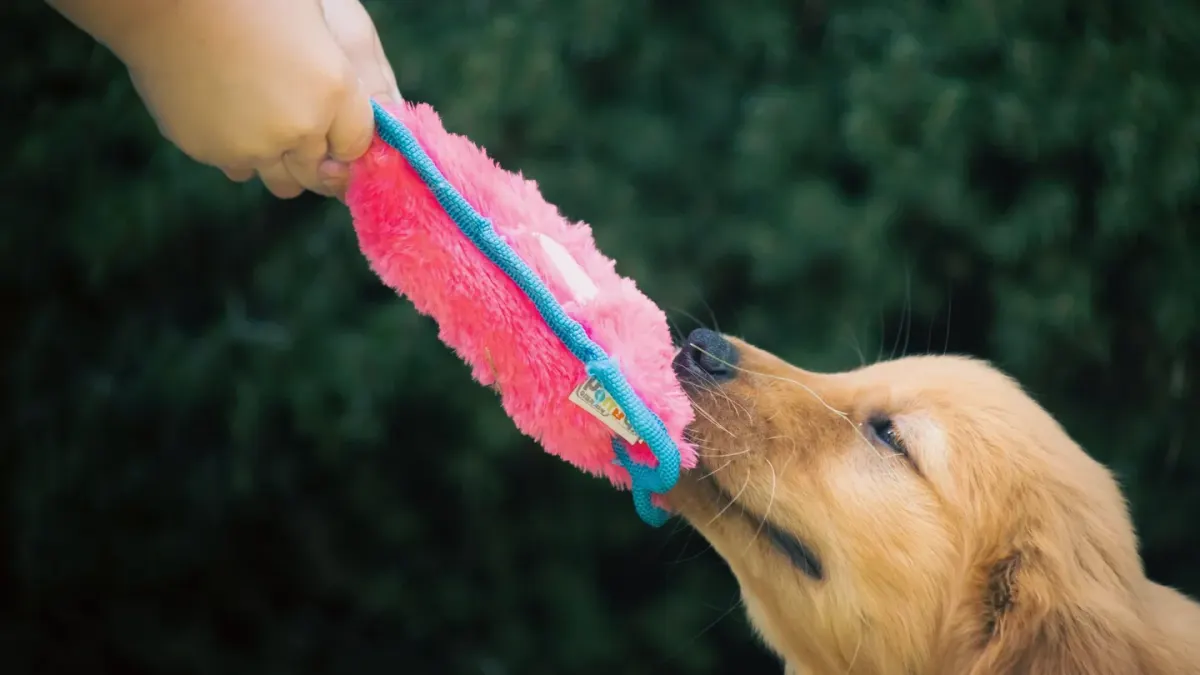
Tug-of-war is good exercise for most dogs, and it earns its keep as both a physical outlet and a form of structured play. It builds grip strength, engages the core and hindquarters, and gives a bored dog something better to do than the couch cushions. The catch is that almost every documented downside — spinal strain, sore jaws, a dog that gets pushy about toys — traces back to how the game is played, not the game itself.
Why the pull direction matters more than the pull itself
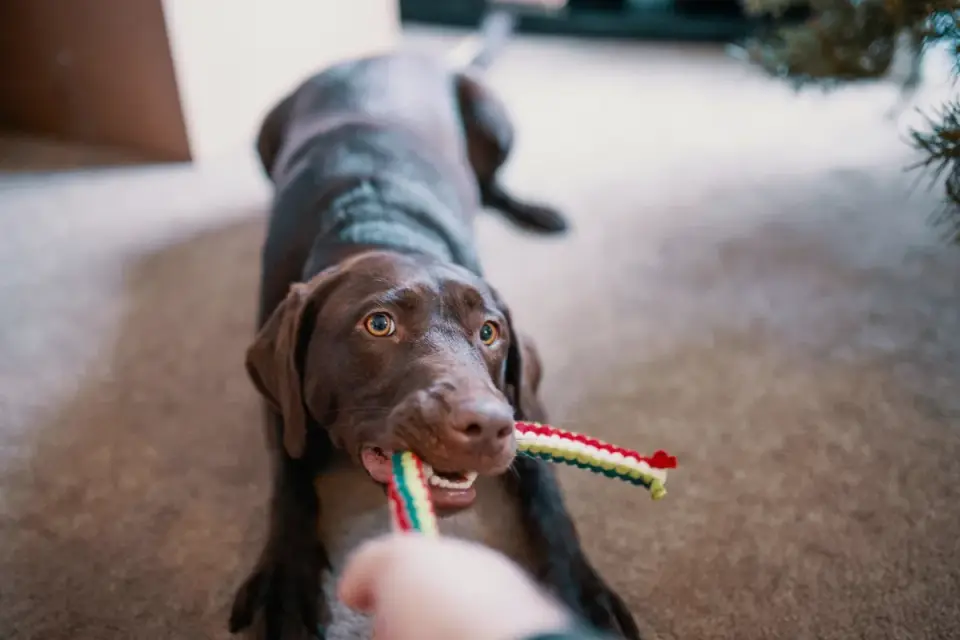
Pulling straight up and down is where most of the trouble starts. When a handler lifts a tug toy high enough that a dog’s front feet leave the ground, or yanks it in a rapid vertical arc, the dog’s neck gets forced into an unnatural arch and the cervical vertebrae absorb pressure they weren’t built to take repeatedly. The American Kennel Club (AKC) has flagged this exact mechanism, noting that dogs in high-drive play often don’t show pain the way we’d expect, so a handler can be causing repetitive strain for weeks before a limp or stiff neck shows up. Their guidance lines up with what I see clinically: keep the toy at roughly the dog’s natural mouth height, tug side to side rather than up, and let the dog use its rear legs and core to pull back instead of hanging from its neck.
Session length matters too. Short bursts — the AKC’s sourcing points to something like 10 to 15 seconds of active pulling per round, with a pause to reset — keep a dog from grinding through repetitive motion long enough to strain something. A dog that’s already breathing hard and locking its jaw for the fourth straight minute isn’t building fitness anymore; it’s accumulating micro-strain.
When tug isn’t the right game
Not every dog is a good tug candidate, and this is where I’d rather be direct than diplomatic. Dogs with diagnosed intervertebral disc disease, existing neck or back injuries, or active arthritis in the front limbs or spine should sit this one out, or play only with very light resistance under a vet’s guidance. Puppies whose growth plates haven’t closed and seniors with any gait changes fall into the same cautious category. If a dog has a history of resource guarding, or escalates quickly from playful growling to a stiff body and hard stare, tug is the wrong outlet regardless of physical fitness — that’s a behavior call, and it sits outside my lane as a nutrition and sports-medicine vet. For that judgment, a certified trainer or veterinary behaviorist watching the dog in real time will read the situation better than any article can.
What’s actually happening in the joints during a hard pull
A vigorous tug match loads the front limbs, shoulders, and cervical spine in ways that aren’t wildly different from a short sprint or a hard game of fetch — brief, high-intensity strain rather than steady mileage. For dogs already managing joint wear, whether from age, breed conformation, or a previous injury, that loading is worth weighing against the dog’s baseline. This is the same lens I use when I look at joint-support ingredients on a label: glucosamine and chondroitin are among the most researched compounds in this category, and a 2026 paper in Frontiers in Veterinary Science found that chondroitin supports healthy synovial fluid homeostasis — the fluid that cushions a joint under exactly this kind of intermittent loading. Separately, a review in the Journal of Veterinary Medical Science noted that glucosamine HCl can help prevent experimentally induced cartilage degradation in vitro, and a study in Nutrients found that green-lipped mussel preparations reduced paw swelling and inflammatory markers in an animal model. None of that means a supplement offsets rough tug technique — it doesn’t — but for an older or previously injured dog whose owner isn’t willing to give up the game, it’s a reasonable piece of the mobility conversation to have with a vet. If you’re comparing labels for that conversation, our breakdown of how we test dog joint supplements walks through what a dose and a COA actually need to show before an ingredient list means anything.
Does tug of war cause aggression or “alpha” behavior?
This is the most persistent myth about the game, and it’s worth naming the counterargument directly: the idea that letting a dog win at tug teaches it to see itself as dominant over its owner, and that this bleeds into other aggressive behavior. I don’t buy it, and neither does the research I’m aware of on tug play and dog-owner interaction, which found no meaningful link between playing tug — including letting the dog win — and increased aggression or disobedience. What does matter is impulse control around the mouth: if teeth touch skin, the game stops immediately, and the dog only gets the toy back once it’s calm. That’s a training rule, not a dominance rule, and it’s the one piece of tug etiquette I’d call non-negotiable regardless of breed or age.
A Border Collie I worked with, about eighteen months old and otherwise a model of self-control at the clinic, had picked up a hard, fast lunge-and-yank style of tugging with her owner’s son, mostly in the backyard after school. Over a couple of months she’d started holding her head slightly tilted and resisting having her collar clipped on. There was no dramatic injury on imaging, just generalized cervical tenderness consistent with repeated strain. We didn’t stop the game — the family loved it and so did she — we changed the angle and the pace: toy at chest height, short rounds, a firm “drop it” cue with a trade for a treat. Six weeks later the head tilt was gone and she was back to full, enthusiastic tugging, just played differently.

A short rubric before your next session
- Pick a long enough toy that your hand stays a foot or more from the dog’s mouth.
- Tug side to side, never up and down; keep the toy near mouth height so the dog uses its hindquarters and core, not its neck.
- Cap active pulling at short rounds — think seconds, not minutes — with a pause and a “drop it” cue between them.
- Stop the second teeth touch skin, and only resume once the dog is calm.
- Skip the game, or use only light resistance, for dogs with known spine, neck, or joint conditions, and for very young or senior dogs.
- If your dog has existing joint wear and you’re not willing to give up tug, talk to your vet about whether a joint-support routine belongs in the conversation alongside technique changes.
Play it this way for a few weeks and most owners notice the same thing I do in the exam room: a tired, satisfied dog with no new stiffness the next morning. That’s really the test. If your dog’s gait, sleep, or willingness to jump onto furniture hasn’t changed after a month of regular tug, the game is doing what good exercise is supposed to do — and there’s no reason to stop it on a technicality about dominance that the evidence doesn’t support.
Frequently asked questions
Is tug-of-war bad for a dog's teeth?
Healthy adult teeth generally tolerate tug play well, but avoid jerking the toy suddenly out of a dog's mouth, which can strain the jaw or chip a tooth on a hard grab. Puppies with baby teeth or dogs with existing dental disease should play with light resistance only.
Can tug-of-war make my dog more aggressive?
Letting your dog win at tug is not linked to increased aggression in the research I'm aware of, as long as basic rules are in place — the game stops the instant teeth touch skin, and the dog releases the toy calmly on cue.
How often can I play tug-of-war with my dog?
Several short sessions a week are reasonable for most healthy dogs. Watch for stiffness, a change in gait, or reluctance to jump the next day; any of those is a sign to shorten sessions or switch to side-to-side pulling with less resistance.
Sources
- Should You Play Tug-of-War With Your Dog? Safety Tips & Benefits — American Kennel Club (AKC)
- Chondroitin sulfate and synovial fluid homeostasis — Frontiers in Veterinary Science
- Glucosamine HCl and experimentally induced cartilage degradation — Journal of Veterinary Medical Science
- Green-lipped mussel preparations and inflammatory markers — Nutrients