On this page
Ten seconds. That’s roughly how long you hold each joint at the end of its comfortable range before easing back — not a number worth memorizing perfectly, but a useful anchor for a technique that owners consistently rush.
I’ve had more than one owner tell me they “did the leg exercises” for a week after a TPLO and saw no difference, then admit under a few more questions that each rep took about two seconds. Passive range of motion, or PROM, is not that. It is a directed, slow, joint-by-joint routine, and its value shows up over weeks, not days.
What passive range of motion actually is
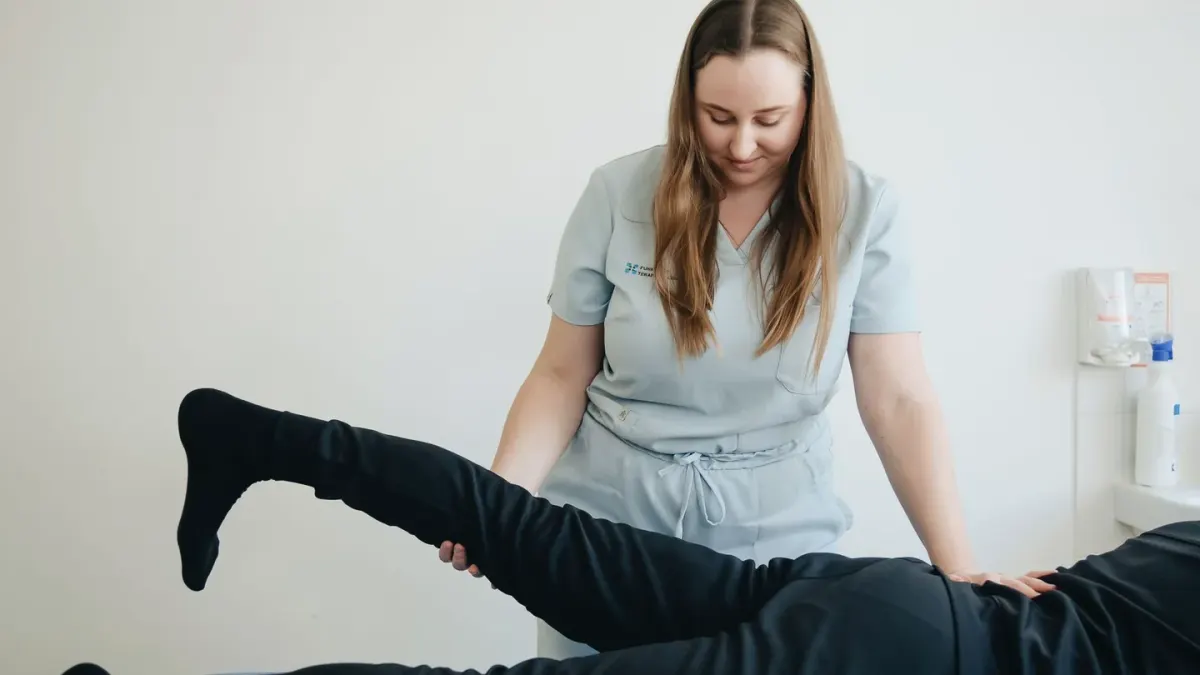
PROM means a person — not the dog — moves a joint through the motion it would normally make on its own, without the dog contracting the surrounding muscle. According to Washington State University’s Veterinary Teaching Hospital, passive exercise is designed to maintain function and increase the movement available in a joint or limb through gentle stretches and motions of muscles and tendons, and it can help dogs recovering from neurologic or musculoskeletal injury by preventing muscle contracture and pain. It’s also one of the more accessible rehabilitation modalities described by VCA Animal Hospitals, which lists it alongside massage, stretching, and therapeutic exercise as tools used in canine physical rehabilitation.
This distinction matters because PROM is not the same as encouraging a dog to walk, stretch itself, or “work out” a stiff leg. It’s closer to physical therapy done to a limb than exercise done by a dog.
When it’s actually indicated
PROM tends to come up in three situations: post-surgical recovery (cruciate repair, TPLO, FHO), documented osteoarthritis with reduced joint mobility, and any period of forced rest long enough to cause disuse atrophy — a dog in a cast, a dog on strict crate rest, a dog too painful to bear weight normally. It is not a substitute for diagnosis. If your dog is suddenly non-weight-bearing, yelping on movement, or has a hot, swollen joint, that’s a vet visit first, PROM second, if at all.
How to actually do it, step by step
- Get the dog relaxed on its side. Most protocols position the dog in lateral recumbency on a flat, padded surface — a folded blanket on the floor works. A tense dog fighting the position defeats the purpose.
- Support the limb properly. Cradle the limb above and below the joint you’re working, keeping it moving in its natural plane rather than twisting it sideways.
- Start distal, move proximal. Work from the toes up through the hock, then the stifle (knee), then the hip — or from the wrist up through the elbow and shoulder on a front leg. The Veterinary Nurse describes exactly this distal-to-proximal sequencing as standard technique, moving each joint slowly until natural resistance is met.
- Flex, hold, extend, hold. Move the joint gently to the end of its comfortable range, pause briefly, then bring it back. Do not push through resistance or force a stretch — you’re looking for the joint’s available range that day, not yesterday’s or next month’s.
- Repeat in short sets. A common pattern is roughly 10 repetitions per joint, a few times a day, though your vet or rehab therapist will adjust this to your dog’s specific surgery or condition and tell you exactly how many sets and how often.
- Stop at any sign of pain. Vocalizing, pulling away, or guarding the limb means you stop and check in with your veterinarian rather than pushing on.
The whole routine for one leg usually takes a few minutes once you’re comfortable with it. It should never feel like a fight.
Where owners go wrong
The single biggest mistake I see is speed — owners treat PROM like a countable rep instead of a slow, held stretch, so the joint never actually spends time at end range. The second is skipping the distal joints. It’s tempting to go straight for the stifle after a TPLO because that’s the surgical site, but the toes and hock stiffen too during weeks of reduced use, and ignoring them shows up later as a subtly short stride.
I think about one Labrador retriever I worked with, about nine years old and sixty pounds, four weeks post-TPLO, whose owner had been diligently icing the knee but skipping the ankle and toes entirely because “that wasn’t the surgery leg’s problem.” By week five, the dog was full weight-bearing at the stifle but still landing stiffly through the paw on that side, especially first thing in the morning. Once we added distal PROM — toes and hock, not just the knee — into the routine, the owner reported a visibly smoother first-few-steps-of-the-day gait within about two weeks. That’s one dog, not a study, but it’s the pattern I’ve seen enough times to take the distal joints seriously.
Where supplements fit, and where they don’t
PROM addresses mechanics — the joint’s available range of motion and the soft tissue around it. It does not address the underlying inflammatory or cartilage biology of osteoarthritis, which is a separate piece of the puzzle some owners try to manage nutritionally alongside physical rehab. Glucosamine and chondroitin remain among the most studied joint-support ingredients for dogs; chondroitin has been examined for its role in supporting healthy synovial fluid homeostasis (DOI:Frontiers in Veterinary Science: 10.3389/fvets.2026.1536366), and glucosamine HCl has been studied for its ability to help prevent experimentally induced cartilage degradation in vitro (DOI:Journal of Veterinary Medical Science: 10.1292/jvms.25-0293). Green-lipped mussel powder has shown effects in reducing paw swelling and markers of inflammation in animal models, according to a study published in Nutrients (DOI:10.3390/nu18020215).
None of that replaces the mechanical work PROM does, and none of it is a substitute for a rehab plan built around your dog’s actual surgery or diagnosis. I’d treat a joint supplement as a complement to a mobility plan, not a stand-in for the plan itself — a distinction worth weighing honestly before you decide where your money and effort go.
What good technique looks like over time
By the time an owner has been doing PROM correctly for two to three weeks, the change is usually visible in daily life before it shows up on any formal measurement — a dog who was hesitant to fully extend a leg during a stretch first thing in the morning starts doing it on its own, or a limb that felt noticeably stiffer than its pair on exam starts to feel more symmetrical. That’s the practical marker to watch for, more than counting degrees with a goniometer at home. If our publication’s approach to joint-support products interests you, our guide on how we test dog joint supplements walks through the same label-first, evidence-first standard we apply here.
If a dog isn’t improving after a few weeks of consistent, correctly performed PROM, that’s a conversation for your veterinarian or a certified canine rehabilitation therapist, not a reason to push harder on your own.
In short: PROM is slow, deliberate, joint-by-joint work done by a person to a relaxed dog — not a stretch the dog does itself, and not a fix for everything that ails an aging or recovering joint.
Frequently asked questions
How often should I do passive range of motion exercises with my dog?
Frequency depends on the reason for PROM — post-surgical protocols often call for several short sessions a day for the first weeks, while general stiffness from arthritis or rest may need less. Always follow your veterinarian's or rehab therapist's specific instructions rather than a one-size-fits-all schedule.
Can I start PROM exercises without veterinary guidance?
It's best to have a veterinarian or certified canine rehabilitation therapist show you the technique first, especially after surgery. Moving a joint incorrectly, too far, or too soon can aggravate healing tissue.
Is passive range of motion painful for the dog?
Done correctly, PROM should stay within a comfortable range and not cause pain. Vocalizing, pulling away, or guarding the limb are signs to stop and check in with your veterinarian.
Sources
- Passive range of motion exercises | Veterinary Teaching Hospital — Washington State University
- Rehabilitation Modalities — VCA Animal Hospitals
- How to perform effleurage and passive range of motion exercises — The Veterinary Nurse
- Chondroitin sulfate and synovial fluid homeostasis — Frontiers in Veterinary Science
- Glucosamine HCl and cartilage degradation in vitro — Journal of Veterinary Medical Science
- Green-lipped mussel powder and inflammatory markers — Nutrients