On this page
- Why the Surface Under the Paw Matters More Than the Word “Exercise”
- Walking: What It Trains, and What It Costs
- Swimming: What It Trains, and What It Costs
- Where I Land, and the Argument Against It
- Where Joint-Support Ingredients Fit, and Where They Don’t
- Building a Week That Actually Fits an Arthritic Dog
Start with the checklist. Expand it below.
- If your dog is flaring (limping, reluctant to rise, painful on palpation): favor swimming or shallow wading over walking until the flare settles.
- If your dog is stable but stiff: short, frequent walks on flat, even ground beat one long walk.
- If your dog is losing muscle mass over the hindquarters: add land work back in — swimming alone won’t rebuild it.
- If stairs or the couch have become a production: this is a strength problem as much as a pain problem, and walking addresses strength in a way water can’t fully replace.
- If your dog won’t get in the water at all: don’t force it. A reluctant swimmer under stress can tense against the very joints you’re trying to protect.
- Either way, watch the 24-hour window: soreness the day after a session, not during it, is the signal that tells you whether you pushed too far.
I want to be direct about where I land before I walk through the reasoning: for most arthritic dogs, walking is the default and swimming is the tool you reach for during flares or when a specific joint needs to move without bearing weight. That’s a narrower claim than “swimming is better because it’s low-impact,” which is the version I hear most often from owners, and I think it undersells what land conditioning does for a dog with arthritis.
Why the Surface Under the Paw Matters More Than the Word “Exercise”
Arthritis isn’t one problem — it’s cartilage that’s already compromised, a joint capsule that’s often thickened and less forgiving, and muscle around that joint that atrophies quietly as the dog compensates. Water and land ask different things of that system. Buoyancy in water removes most of the dog’s body weight from the joint, which is exactly why swimming gets recommended so reflexively. But weight-bearing is also how bone and connective tissue stay conditioned, and how the stabilizing muscles around an arthritic hip or elbow keep doing their job. Take weight-bearing away entirely and you can lose ground on the second problem while solving the first.
In my practice, the dog I think about most often here was a nine-year-old Labrador named Gus, sixty-one pounds, with bilateral hip arthritis that had been managed for about two years. His owner had read that swimming was the gentler option and had shifted him almost entirely to a pool session twice a week, cutting his daily walks down to bathroom breaks. Gus was comfortable in the water and clearly enjoyed it. But over about four months, his owner noticed he was struggling more to get up off the kitchen floor, and when I felt through his hindquarters, the muscle over both hips had visibly thinned compared to his last exam. We hadn’t taken away his pain source, but we’d taken away the loading that kept his hip stabilizers doing their job. We added back two short, flat walks a day alongside the swimming, and by the next recheck the muscle mass had started to return.
Walking: What It Trains, and What It Costs
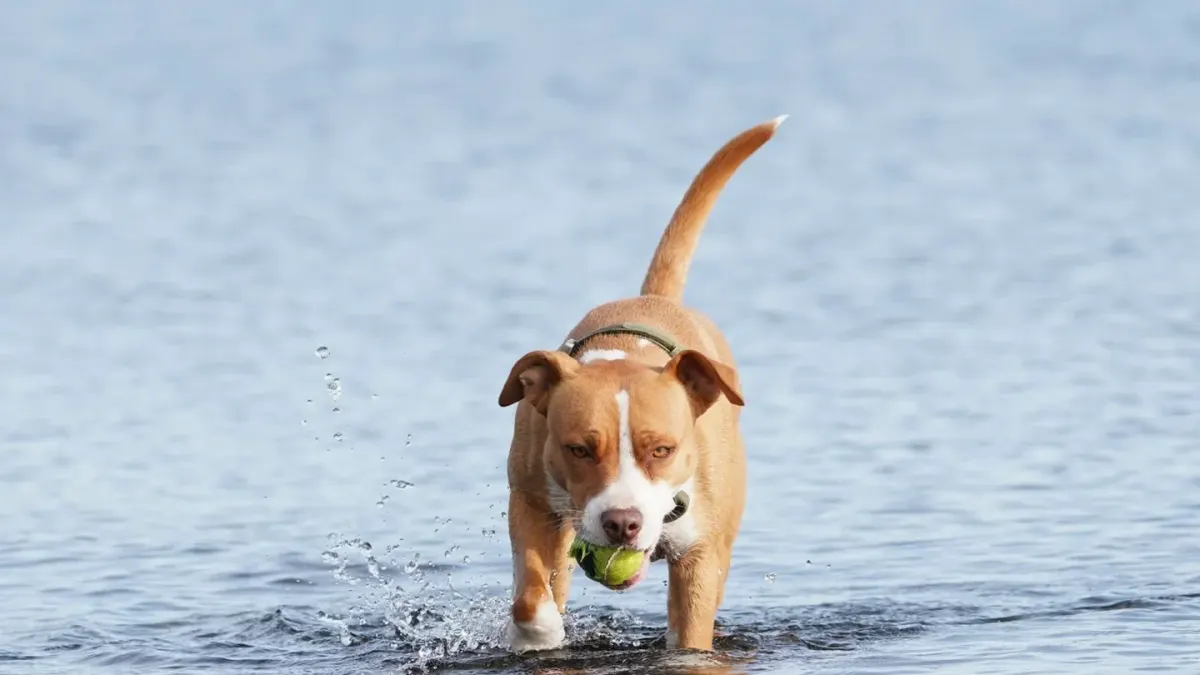
A walk on flat, predictable ground is weight-bearing, low-speed, and — critically — controllable in a way almost nothing else is. You can shorten it, slow it, or stop it the moment your dog shows discomfort. That controllability is why I default to walking for most stable arthritic dogs: short sessions, several times a day, on a surface with good traction, rather than one long walk that asks the joint to do more work late in the session than it can tolerate. The cost is real, though. Walking loads the joint every step, on hard or uneven ground it can jar a compromised joint capsule, and a dog that’s overdue for a walk can move in a way that overshoots what the joint can handle that day.
Swimming: What It Trains, and What It Costs
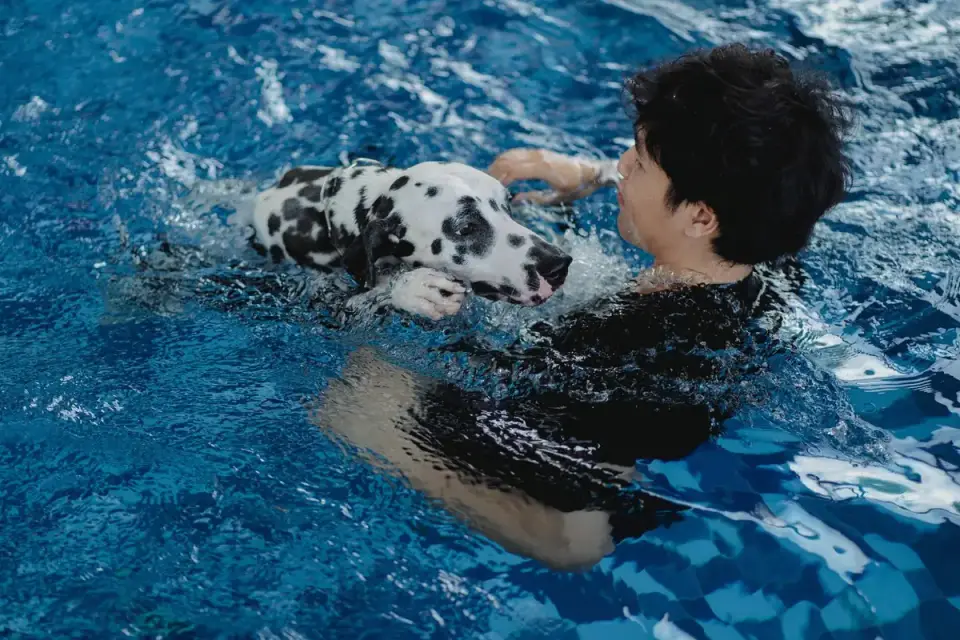
Swimming — true swimming, not standing in shallow water — takes the joint through a wide range of motion with almost none of the compressive load of standing or walking. For a dog in an active flare, or one recovering from a joint procedure, that’s the exact combination you want: movement without weight. The cost is that swimming trains cardiovascular fitness and some muscle endurance, but it doesn’t replicate the proprioceptive demand or the specific loading pattern of walking on land, and not every arthritic dog tolerates it. Anxious swimmers, dogs with ear or skin sensitivities, and dogs who simply never took to water aren’t good candidates, and forcing the issue adds a stress response that works against the goal.
Where I Land, and the Argument Against It
My position is that walking should be the daily baseline for a stable arthritic dog, with swimming layered in during flares, after procedures, or as a supplemental conditioning session — not the other way around. The strongest counterargument, and one I take seriously, is that walking on hard or uneven surfaces is genuinely harder on a compromised joint than a controlled pool session, and that for a dog with severe, poorly controlled arthritis, the day-to-day compressive load of walking may outweigh the muscle-conditioning benefit. That’s a fair point, and it’s exactly why the checklist above starts with flare status rather than a blanket recommendation. A dog in a bad flare should be swimming or resting, not walking through it. But once a dog is stable, I don’t think the injury risk of a short, flat, well-paced walk is high enough to justify skipping the loading that keeps hip and shoulder stabilizers functional. The evidence I’d want to see to change my mind is a head-to-head trial comparing muscle mass and functional scores between arthritic dogs on a walking-only versus swimming-only protocol over several months — to my knowledge, that specific comparison hasn’t been run in dogs, so this recommendation is built on load physiology and clinical pattern, not a controlled trial of exercise type itself.
Where Joint-Support Ingredients Fit, and Where They Don’t
Neither swimming nor walking addresses the cartilage biology underneath the joint, which is where oral joint support ingredients come in — as an adjunct, not a substitute for the right exercise plan. Chondroitin has research behind it for supporting healthy synovial fluid homeostasis, per a study in Frontiers in Veterinary Science. Glucosamine HCl, in laboratory conditions, has been shown to help prevent experimentally induced cartilage degradation in vitro, according to a review in the Journal of Veterinary Medical Science — worth noting that’s an in-vitro finding, not a clinical outcome claim. And green-lipped mussel powder, tested in a rodent inflammation model, alleviated paw swelling and reduced serum markers including TNF-α and IL-17, per a study in Nutrients. None of that tells you which exercise to choose. It tells you that the ingredient side and the movement side are solving different parts of the same problem, and a dog doing everything right on exercise can still benefit from label-checked, dosed-correctly joint support alongside it. If you’re evaluating a specific product rather than the exercise question, that’s a separate rubric — we walk through how we check labels and doses in How We Test Dog Joint Supplements — and What to Check.
Building a Week That Actually Fits an Arthritic Dog
Near the end of most consults on this topic, I come back to the same image. The owners I see most often aren’t choosing between swimming and walking in the abstract — they’re standing in their kitchen at 6 a.m. with a dog who’s stiff getting up, trying to decide whether today is a walk day. What I tell them is to build the week around flare status, not a fixed schedule: two to three short flat walks most days, a swim session worked in weekly or during a bad stretch, and a hard rule that any single session gets cut short the moment the dog shows a hitch in the gait, not after. The dogs that do best over a year aren’t the ones on the most sophisticated protocol. They’re the ones whose owners actually watch the dog and adjust, session by session, rather than committing to one modality because it sounded gentler on paper.
Frequently asked questions
Is swimming better than walking for a dog with arthritis?
Neither is categorically better — they train different things. Swimming reduces joint load and is useful during flares or after a procedure; walking maintains the muscle and bone conditioning around the joint. Most stable arthritic dogs do best with walking as the daily baseline and swimming layered in as needed.
How do I know if my dog is having a flare versus just being stiff?
A flare usually looks like reluctance to move at all, pain on touch around the joint, or a limp that doesn't warm out of walking. General stiffness tends to ease within the first few minutes of movement. When in doubt, favor lower-impact activity and check with your veterinarian.
Can swimming alone maintain muscle mass in an arthritic dog?
Not reliably on its own. Swimming supports cardiovascular fitness and joint range of motion, but it doesn't replicate the weight-bearing load that keeps hip and shoulder stabilizer muscles conditioned, which is why land-based movement usually needs to stay in the routine.
Sources
- Chondroitin sulfate and synovial fluid homeostasis — Frontiers in Veterinary Science
- Glucosamine HCl and cartilage degradation, an in vitro review — Journal of Veterinary Medical Science
- Green-lipped mussel powder in an adjuvant-induced arthritis model — Nutrients