Dog Arthritis or a Temporary Injury? How to Tell the Difference
Medically reviewed by Michael Bartholomew, DVM, CVA, MSTCVM, CVCH, CVFT, CVTP — For general education — not a substitute for veterinary care.
The single fastest tell isn't the limp itself — it's whether the stiffness gets better or worse after ten minutes of gentle movement.
On this page
If your dog is favoring a leg right now, you don’t want a literature review. You want a decision. So here’s the direct answer: a temporary injury tends to hurt worse at the moment it happens and then steadily improve day over day; arthritis tends to look mild at first, worsens with rest, and eases — then stiffens again — in a predictable daily rhythm. That single distinction, rest-response versus time-response, is the criterion I lean on hardest in exam rooms, and it’s the one most owners haven’t been told to watch for.
The scene that makes this concrete
A nine-year-old Labrador, 72 pounds, comes in because she “just started limping yesterday.” The owner is sure it’s new — she was fine on Monday, off on Tuesday. But when I ask her to walk the dog around the parking lot, the limp is worse for the first thirty steps and then nearly disappears. That warm-up pattern is a classic arthritis tell, not a fresh sprain. A true acute injury from three days ago would usually still show swelling or heat over one specific joint, and it would get worse with exercise, not better. The owner’s instinct — “something just happened” — was picking up a flare, not an onset.
The criteria I actually check, in order
Four things separate the two most reliably, and I go through them roughly in this order because each one narrows the field faster than the last.
1. Onset pattern. A soft-tissue strain has a moment — a bad landing, a slip on tile, a hard sprint after a squirrel. Arthritis rarely has one; it creeps in, and owners often can’t name a day it started.
2. Movement response. This is the criterion from the top of this article, and it’s the most useful one you can apply at home. Walk your dog slowly for five to ten minutes. A strained muscle or ligament usually gets worse the longer you go. Arthritic stiffness usually loosens up, then can stiffen again after a long rest.
3. Symmetry and location. Injuries are almost always one limb, one joint, sharply localized. Arthritis is often bilateral even when one side looks worse, and it clusters at hips, stifles (knees), elbows, and the lower spine in older, larger dogs.
4. Duration under conservative rest. Give a true strain 5–7 days of restricted activity and it should measurably improve. If a dog is not meaningfully better by day 10, I stop calling it “probably just a pull” and start working it up as joint disease.
Where an owner’s instinct goes wrong
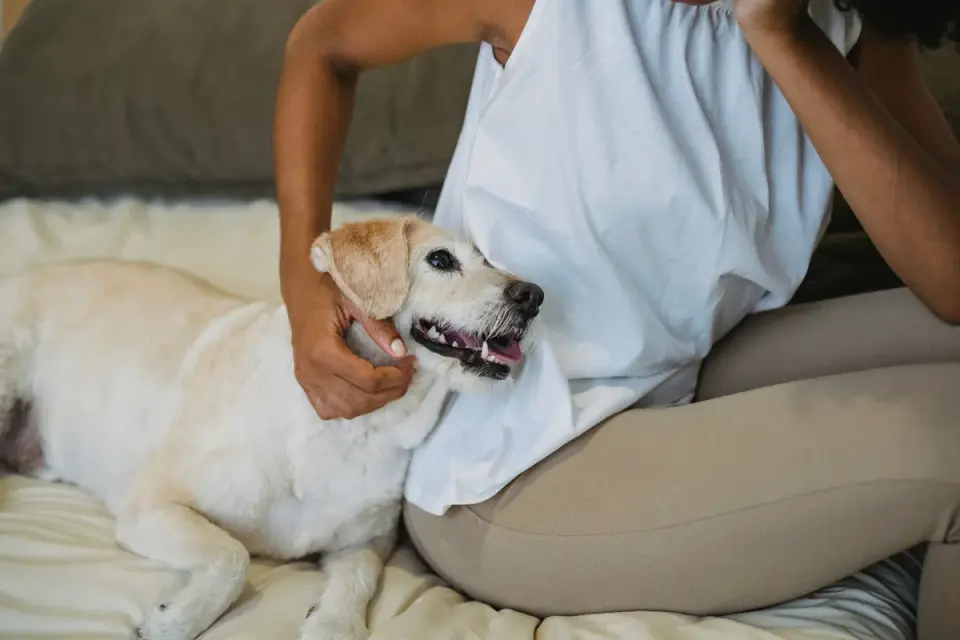
I’ve watched this misread go both directions, and the more common failure isn’t panic — it’s under-reaction. A 5-year-old Border Collie, 42 pounds, was brought in after “tweaking” her back leg on a hike. The owner rested her for two weeks, no vet visit, assuming a strain that would resolve on its own. By day 14 the dog was still stiff after naps and slow to rise in the morning — a rest-response pattern, not an injury-response pattern. What looked cautious was actually a delay: two weeks of no movement can itself stiffen a joint further and mask what’s really going on. The lesson I take from that case is that “give it more time” is not a neutral choice when the pattern already points to arthritis; it can cost you the early window where structure/function support has the most room to work.
What I’d do differently for a young, large-breed dog
Age and breed change how much weight I give each criterion. In a growing giant-breed puppy — say a 7-month-old Great Dane at 65 pounds — sudden lameness after normal play is far more likely to be a developmental issue (panosteitis, growth-plate stress, or a soft-tissue strain) than degenerative arthritis, which is uncommon at that age outside of hip or elbow dysplasia. I still apply the same four-point checklist, but I weight duration and imaging much more heavily before assuming anything chronic, because young joints can mask serious orthopedic problems as “just stiff.” That’s the edge case worth remembering: the criteria are directionally reliable, but the baseline odds shift hard with age and breed, and that shift should change how fast you escalate to your vet rather than watch and wait.
What structure/function support can and can’t tell you
Once you’re reasonably confident you’re dealing with arthritis rather than a passing strain, ingredient-level evidence becomes relevant. Frontiers in Veterinary Science: Glucosamine and chondroitin are among the most studied joint support ingredients for dogs, and current research indicates chondroitin supports healthy synovial fluid homeostasis, which is the lubricating environment inside an arthritic joint — not a claim that it repairs damaged cartilage or cures the disease. Separately, research in Journal of Veterinary Medical Science indicates that glucosamine HCl has been shown in laboratory research to help prevent experimentally induced cartilage degradation in vitro, evidence that speaks to the ingredient’s mechanism rather than a guarantee of outcome in a living dog. And research published in Nutrients showed that Green-Lipped Mussel extract, in animal studies, alleviated paw swelling and reduced markers of inflammation such as TNF-α and IL-17 — again, mechanism-level support, not a promise of resolution.
I think of these three ingredients the way I think of any TCVM-aligned protocol: one part of an integrative plan, not a stand-alone fix. In practice terms, that means pairing a joint-support ingredient with weight management, appropriate exercise, and — where indicated — acupuncture or Tui-na bodywork aimed at the same stiff structures the label is trying to support from the inside. Eastern pattern differentiation (cold-damp bi-syndrome, for example, in a dog who’s worse after rest and better with gentle movement) sits comfortably alongside that plain western structure/function language; they’re describing the same clinical picture from two directions, not competing explanations.
For related reading, see how cold weather affects a dog’s arthritis, how physical therapy fits into an arthritis plan, and how to think through adjusting a joint supplement dose for a senior dog once a diagnosis is clearer.
The counterargument I take seriously
The obvious pushback: “you can’t diagnose arthritis without imaging, so why give owners a home checklist at all?” That’s fair, and I won’t pretend a parking-lot walk replaces radiographs. But most owners aren’t deciding between two diagnoses — they’re deciding whether to wait a week or call today. The four-point pattern doesn’t replace your vet’s exam; it tells you which direction to lean while you’re waiting for the appointment, and it flags the cases (no improvement by day 10, bilateral symmetry, an older large-breed dog) that shouldn’t wait at all.
Where I land
If the stiffness eases with gentle movement, worsens after rest, and shows up on both sides more than one, I’m treating it as arthritis until proven otherwise and building an integrative plan around it. If it’s sudden, one-sided, and gets worse the longer your dog moves, give it a week of real rest and re-check the pattern. Either way, a dog who isn’t clearly better by day 10 has earned a vet visit, not another week of guessing.
Frequently asked questions
Can a dog have both arthritis and a fresh injury at the same time?
Yes — an arthritic joint is more prone to secondary strains, so a dog can flare from both at once, which is part of why a slow response to rest is a signal to see your vet rather than keep waiting.
How long should I wait before calling the vet about a limp?
If a suspected strain hasn't measurably improved within 5–7 days of restricted activity, or your dog is not clearly better by day 10, that's the point to stop assuming it's temporary.
Does warming up out of a limp always mean arthritis?
Not always, but it's one of the more reliable at-home signals. Combine it with symmetry, onset pattern, and duration before drawing a conclusion, and let your vet confirm with an exam.
Sources
- Chondroitin supports healthy synovial fluid homeostasis — Frontiers in Veterinary Science
- Glucosamine HCl prevents experimentally induced cartilage degradation in vitro — Journal of Veterinary Medical Science
- Green-Lipped Mussel Powder alleviates paw swelling and inflammatory markers — Nutrients