
On this page
A twelve-year-old Lab mix named Otis used to sleep through most of the afternoon on the kitchen tile, and every single time he got up, he’d take three or four hitching steps on his back left leg before it smoothed out. His owner called it “waking up on the wrong side,” half joking. It wasn’t a joke — it was a pattern, and patterns are what I trace first.
That’s the habit I bring from internal medicine: don’t react to the limp itself, trace the axis that produced it. Is this a mechanical joint problem, a soft-tissue strain, or something metabolic showing up as stiffness? A dog that limps for the first ninety seconds after standing and then walks normally is telling you something very different from a dog that limps for twenty minutes, or one that’s still off an hour later. The timeline is the diagnosis, more than the limp itself ever is.
The stiffness-warms-out pattern is usually mechanical, not urgent
Cartilage doesn’t have its own blood supply — it depends on synovial fluid moving through the joint to stay lubricated, and that fluid thickens when a dog has been still for hours. Chondroitin has been studied specifically for its role in Frontiers in Veterinary Science: supports healthy synovial fluid homeostasis, which is the mechanism behind a lot of post-nap stiffness: the fluid needs a few minutes of motion to redistribute before the joint moves freely again. That’s why the “walks it off in under two minutes” pattern is so common in otherwise healthy dogs, especially ones over seven or eight years old.
Glucosamine plays a related but different role. Research summarized by the Journal of Veterinary Medical Science describes glucosamine’s ability to help prevent experimentally induced cartilage degradation in vitro — meaning it’s studied more as a structural building block than a lubricant. Together, glucosamine and chondroitin are frequently paired in joint formulas because they’re addressing two separate parts of the same axis: the cartilage matrix and the fluid around it.
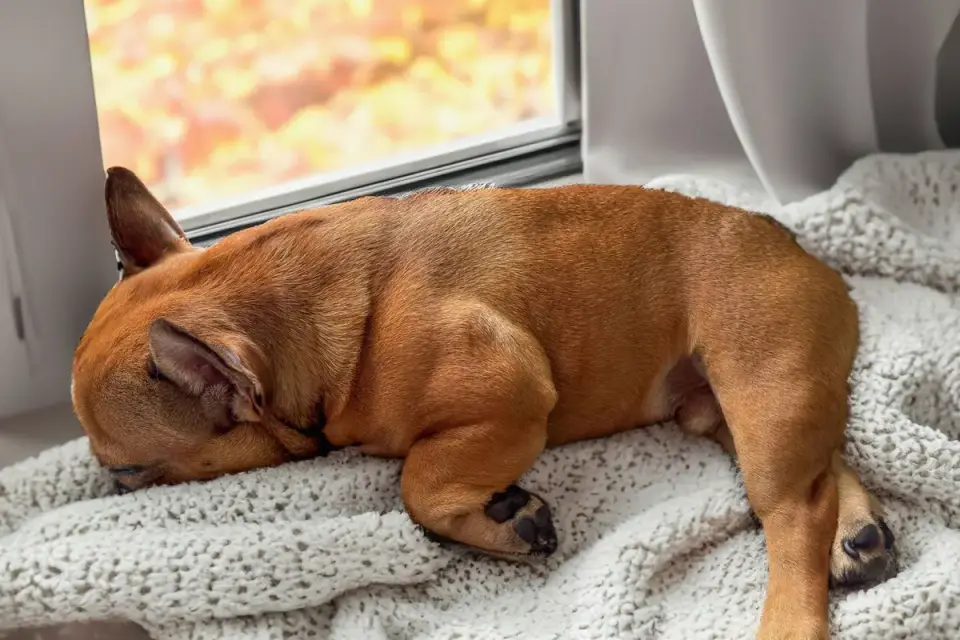
When the limp doesn’t warm out, the differential changes
Here’s where I slow down. A limp that resolves in under two minutes points toward ordinary joint stiffness. A limp that persists past ten or fifteen minutes, gets worse with exercise instead of better, or is paired with a dog that’s reluctant to jump onto the couch or take stairs — that’s a different differential. It could be early osteoarthritis, a soft-tissue injury like a partial cruciate tear, or in younger large-breed dogs, a developmental issue such as elbow dysplasia. If you want to understand what that diagnosis actually involves, our piece on what elbow dysplasia actually means when a vet says it out loud walks through it in plain language.
One dog I worked with, a seven-year-old Rottweiler named Bea, sixty-two pounds, only ever limped after her long overnight sleep — never after a daytime nap on the same floor. Her owner had noticed it for about three weeks before mentioning it, and the detail that mattered was the duration: fifteen to twenty minutes of a hitching gait on cold mornings, versus barely a hitch after a twenty-minute afternoon nap in the sun. That asymmetry between a long, cold overnight rest and a short, warm daytime one is a real clinical clue — it suggests both temperature and duration of immobility are compounding the joint’s stiffness, which points more toward early degenerative change than a one-off muscle strain.
Green-lipped mussel has data behind it here too, though the strongest evidence is preclinical. A study in Nutrients found that green-lipped mussel preparations alleviated paw swelling in rats and reduced serum levels of inflammatory markers including TNF-α and IL-17. That’s rodent data, not a canine clinical trial, so I’d frame it as supportive rather than definitive — but it fits the same axis: reducing the inflammatory load that keeps a joint irritated between periods of rest.
What actually separates “normal stiffness” from “get it checked”
I keep a short mental checklist, and it’s less about the limp and more about the trend:
- Does it resolve in under two minutes, every time? That’s reassuring.
- Is the limp getting longer or more pronounced over weeks, not just varying day to day with weather? That’s worth a visit.
- Is the dog also declining stairs, hesitating before jumping, or sleeping more than they used to? Those are the systemic tells, not just the local ones.
- Is there swelling, heat, or a yelp on touch anywhere along the leg? That warrants an exam regardless of how brief the limp is.
None of that requires a specialist to notice. It requires a week or two of paying attention, ideally written down, because owners consistently underestimate how gradual these changes are until they compare notes across a month.
Where a supplement fits, and where it doesn’t
Supplements support the axis I described above — cartilage matrix and synovial fluid — but they don’t replace a diagnosis. If you’re comparing options, our guide to what actually held up when we read the label walks through how we score dose against the research for products on the market, and what actually belongs in the scoop breaks down which ingredients have the strongest evidence behind them. If you’re newer to this and want the baseline on how to evaluate any joint product before buying, how we test dog joint supplements is the place to start.
The counterargument I hear most is that morning stiffness is “just aging” and doesn’t need attention until it’s severe. I understand the instinct — most dogs do slow down, and not every hitch is pathology. But the axis view says otherwise: cartilage and synovial fluid respond to inputs (movement, weight, inflammation, and yes, targeted nutrients) well before a dog is limping badly enough to worry anyone. Waiting for severe usually means waiting past the point where supportive measures do the most good.
Otis, the Lab mix from the opening, turned out to have mild bilateral hip changes on X-ray — not urgent, but real. His stiffness pattern, three or four steps and done, was exactly the kind of thing that’s easy to dismiss and worth tracking anyway.
So if your dog limps for a minute after a nap and then moves normally the rest of the day, that’s very likely ordinary stiffness working itself out. If the pattern is stretching longer, showing up more often, or spreading to how your dog handles stairs and jumping — what would it take for you to bring that timeline to your vet instead of just watching it another month?
Frequently asked questions
Is it normal for a dog to limp right after waking up?
Yes, brief stiffness lasting under a minute or two after a nap or overnight sleep is common, especially in dogs over seven, and usually reflects synovial fluid needing a few minutes to redistribute through the joint.
When should I take a limping dog to the vet?
See a vet if the limp lasts more than ten to fifteen minutes, is getting worse over weeks, comes with swelling or heat, or is paired with reluctance to climb stairs or jump.
Sources
- Chondroitin and Synovial Fluid Homeostasis in Joint Health — Frontiers in Veterinary Science
- Glucosamine HCl and Cartilage Degradation — Journal of Veterinary Medical Science
- Green-Lipped Mussel Preparations and Inflammatory Markers — Nutrients