Exercise and Rehab Basics After IVDD or a Back Injury
Medically reviewed by Justin Shmalberg, DVM, CVA, ACVN, ACVSMR — For general education — not a substitute for veterinary care.
Exercise for a dog with IVDD isn't about doing less forever — it's about sequencing load correctly so the spine has room to heal.
On this page
How much should a dog with IVDD actually move? That question comes up in almost every recheck I run for a back-injury case, and the honest answer is: it depends entirely on which phase of healing the dog is in, not on a single blanket rule the internet tends to hand out.
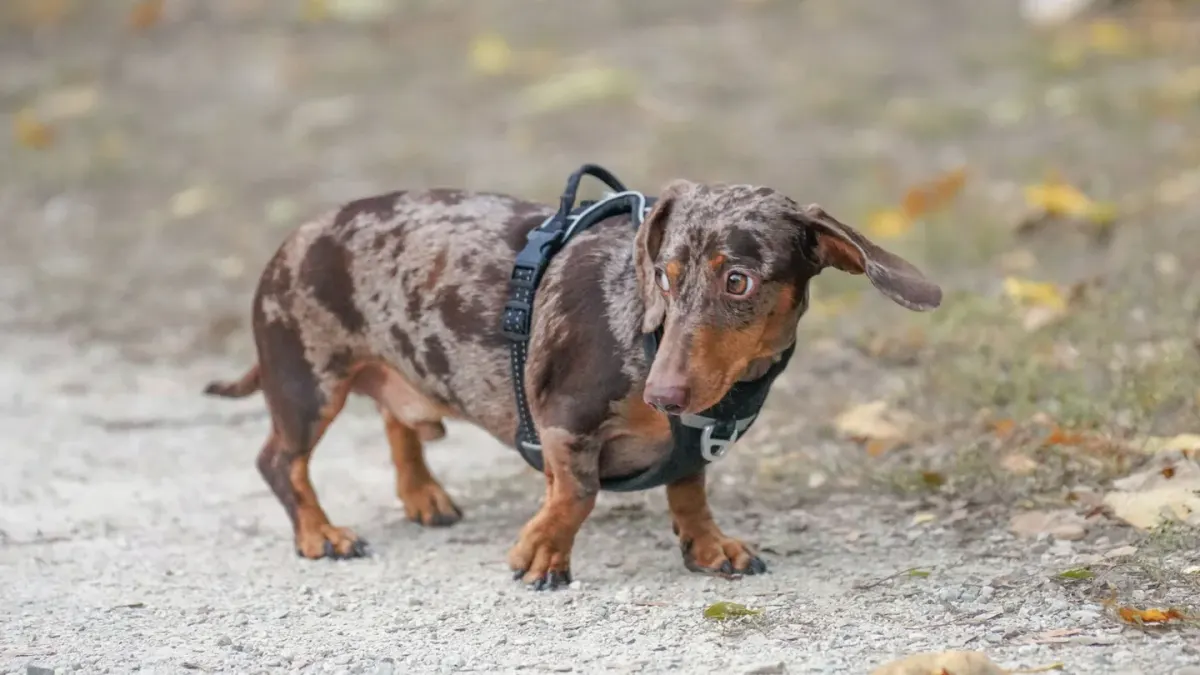
I remember a nine-year-old dachshund, Otis, about 22 pounds, who came in three weeks post-op after a hemilaminectomy. His owner had done everything right for the first two weeks — strict crate rest, sling-assisted potty breaks — but by week three she was terrified to progress him at all, because the surgeon’s “slow return to activity” instruction didn’t come with a schedule. Otis had started dragging a rear toenail on the linoleum kitchen floor specifically, though he was fine on the living room carpet, which told us more about proprioceptive deficit than about pain. We built a plan around five-minute leash walks on flat, non-slip ground, twice a day, adding two minutes every four to five days as long as the toe-drag didn’t worsen. By week six he was walking twelve minutes without dragging. That kind of week-by-week, surface-aware progression — not a fixed “six weeks of rest” number — is what actually moves these dogs forward.
What phase is the dog actually in?
Exercise after IVDD isn’t one protocol; it’s three, and they don’t overlap.
- Acute/post-surgical (roughly weeks 0–2): Strict rest. Crate confinement, sling-assisted or harness-assisted trips outside for elimination only, no stairs, no jumping, no free run of the house.
- Early controlled reintroduction (roughly weeks 2–6, and only with the treating vet or rehab vet’s sign-off): Short, flat, leashed walks measured in minutes, not distance. This is where progression is added gradually and where most owners either under- or over-shoot.
- Return-to-function (week 6 onward, again vet-guided): Longer walks, gentle incline work, targeted strengthening, and eventually normal activity for dogs that respond well — timeline varies enormously by severity, surgical vs. non-surgical management, and the individual dog.
Non-surgical (medically managed) IVDD cases usually follow a similarly staged path but often with a longer initial rest period before any leash-walk phase begins. Either way, the surgeon or treating vet sets the actual timeline; what follows here is the general framework I use to talk owners through it.
What actually counts as “controlled” movement
A controlled walk isn’t a walk that happens to be short — it’s one where the surfaces, pace, and turns are all deliberately managed. Flat, non-slip ground beats grass or hardwood for early reintroduction, because slipping is exactly the kind of sudden lateral load a healing disc doesn’t need. A harness that doesn’t put pressure across the neck or chest in a way that torques the spine is preferable to a collar during this phase. Straight-line walking is safer than off-leash wandering, because tight turns and sudden direction changes are where dogs re-load a still-vulnerable segment. And pace matters more than most owners expect: a dog that wants to trot should be slowed, not because trotting is inherently dangerous later, but because early tissue doesn’t benefit from unpredictable impact.
For dogs whose home layout makes stairs unavoidable, a ramp or a carry — not a leash-assisted climb — is the safer bridge until the vet clears stair use. This is one of the areas where working alongside a formal rehab program pays off, because a rehab vet or certified rehab tech can assess gait and proprioception in a way a hallway observation can’t replicate.
Where nutrition and joint support fit — and where they don’t
I get this question almost every time: “should I put him on a joint supplement while he recovers?” The honest structure/function answer is that ingredients like glucosamine and chondroitin are studied for supporting joint tissue and cartilage — not spinal disc healing. Frontiers in Veterinary Science: Glucosamine and chondroitin are among the most studied joint support ingredients for dogs, and chondroitin specifically has been shown to support healthy synovial fluid homeostasis in recent research. Separately, in vitro work on glucosamine HCl has looked at its ability to help prevent Journal of Veterinary Medical Science: experimentally induced cartilage degradation — again, cartilage biology, not disc regeneration.
Green-lipped mussel is the other ingredient owners frequently ask about, largely because it shows up in general joint blends. In laboratory models, Nutrients: green-lipped mussel extract preparations alleviated paw swelling in rats and reduced markers of inflammation, which is interesting mechanistic data on inflammatory pathways — but it’s not evidence that any supplement changes an IVDD timeline. I ground that distinction in the nutritional evidence deliberately: a joint supplement may help support the surrounding musculoskeletal system a dog leans on during a slow return to activity, but it is not a substitute for the surgical, medical, and rehab decisions that actually manage disc disease. If a vet has cleared a joint supplement as part of a broader recovery and long-term mobility plan, that’s a reasonable structure/function conversation to have — it’s just a separate conversation from the exercise protocol itself.
Watching for setbacks, not just progress
Here’s a short one: any new dragging, stumbling, yelping, or reluctance to move that appears after a prior improvement is a reason to call the vet that day, not to wait for the next scheduled recheck.
I’ve had owners describe this exact pattern more than once — a dog doing well at week four, then suddenly reluctant to get up from a nap, or dragging a foot that had been tracking fine. It’s rarely dramatic. It’s a subtle change against a baseline the owner has been watching closely, which is exactly why keeping a simple log — walk length, surface, any stumbling, willingness to jump onto furniture — matters more than owners expect going in.
A dog with a back injury shares more in common with a dog recovering from cardiac or orthopedic surgery than owners often assume: the exercise question is never really “how much,” it’s “how much, on what surface, at what pace, cleared by whom.” The same staged-return logic shows up when owners ask whether a dog with a heart murmur can exercise, or when a dog can run again after being spayed or neutered — different tissue, same principle of matching load to healing stage.
Building the plan that actually fits the dog
Once a dog is cleared past the early leash-walk phase, the work shifts from “how far” to “how well-controlled.” That’s where balance and proprioception work, and eventually core strengthening, come in — but only after the treating vet or rehab specialist confirms the dog is ready. Owners sometimes want to jump straight to balance and proprioception exercises because they’ve read that they rebuild stability quickly; in a healing spine, sequencing still matters more than enthusiasm.
I think of the whole arc as three questions asked in order, every time a dog with IVDD comes back for a recheck: is the dog neurologically stable right now, has the current activity level been tolerated without new signs, and is there room to add a small, specific increment. That’s a slower process than most owners want, and slower than most generic “return to exercise” articles imply. But in my experience, the dogs who progress fastest overall are the ones whose owners resisted the urge to rush week three because week two went well.
Frequently asked questions
How soon can a dog with IVDD go for a walk?
Timing depends entirely on whether the case was managed surgically or medically and on the individual dog's neurologic status — this is a decision for the treating vet or rehab specialist, not a fixed calendar date.
Can a joint supplement help a dog recovering from IVDD?
Ingredients like glucosamine, chondroitin, and green-lipped mussel are studied for joint and cartilage support, not disc healing; any use during IVDD recovery should be discussed with the treating vet as a separate piece of the overall plan.
What's a warning sign that exercise progressed too fast?
New dragging, stumbling, yelping, or reluctance to move after a period of improvement warrants a same-day call to the vet rather than waiting for the next scheduled recheck.
Sources
- Chondroitin sulfate and synovial fluid homeostasis — Frontiers in Veterinary Science
- Glucosamine HCl and cartilage degradation — Journal of Veterinary Medical Science
- Green-lipped mussel extract and inflammatory markers — Nutrients