On this page
Five ground poles laid on grass told me more in two minutes than a full gait exam on tile. The 9-year-old, 68-pound Labrador in front of me shortened his left hind step, clipped pole three, then swung wide to avoid pole four. That clean miss is why I still start almost every mobility workup with cavalettis.
He had been doing longer walks to “build muscle,” but endurance was not his limiter. Foot placement was. By day 10 of short, slow cavaletti sessions paired with his regular food and joint-support routine, his handler could hear the difference — no more toe scrape on the driveway, just even footfalls. Cavaletti poles did not create strength from nothing; they exposed the deficit so we could train it.
This is where I land on supplements alongside exercise: weigh what a supplement can realistically do for diet, mobility, and recovery. Ground an integrative claim in the nutritional evidence, and frame benefits as may help support whole-patient health. Glucosamine and chondroitin are among the most studied joint support ingredients for dogs, and that history matters when a dog is loading joints repeatedly in rehab. The strongest counterargument is fair — exercise drives the adaptation, not powder in a bowl — and I agree that no chew replaces repetitions. I still keep a foundation joint supplement in the plan during cavaletti blocks because consistent daily intake may help support normal joint structure while training provides the stimulus.
Lay the first set for the dog you have today
Measure, do not eyeball. Start with poles on the ground, no elevation.
Set 4–6 poles in a straight line on non-slip grass, mat, or carpet. Space them at roughly the dog’s natural step length: wrist-to-elbow distance for forelimbs is a practical field check, but watch the dog, not the tape. Small dogs often start at 8–12 inches, medium dogs at 14–20 inches, large dogs at 20–28 inches.
Walk the dog on a loose leash at a slow walk. Trot comes later. Cue forward, keep your shoulders quiet, reward after the last pole — not over a pole. Do 3–5 passes, rest 1–2 minutes, repeat once. Stop while the dog is still clean. Film from the side at hip height. Count knocks, skips, and rushes.
If the dog consistently steps between poles without lifting, narrow spacing by 2 inches. If he bunches or jumps, widen spacing by 2 inches.
Add height only when the walk stays clean
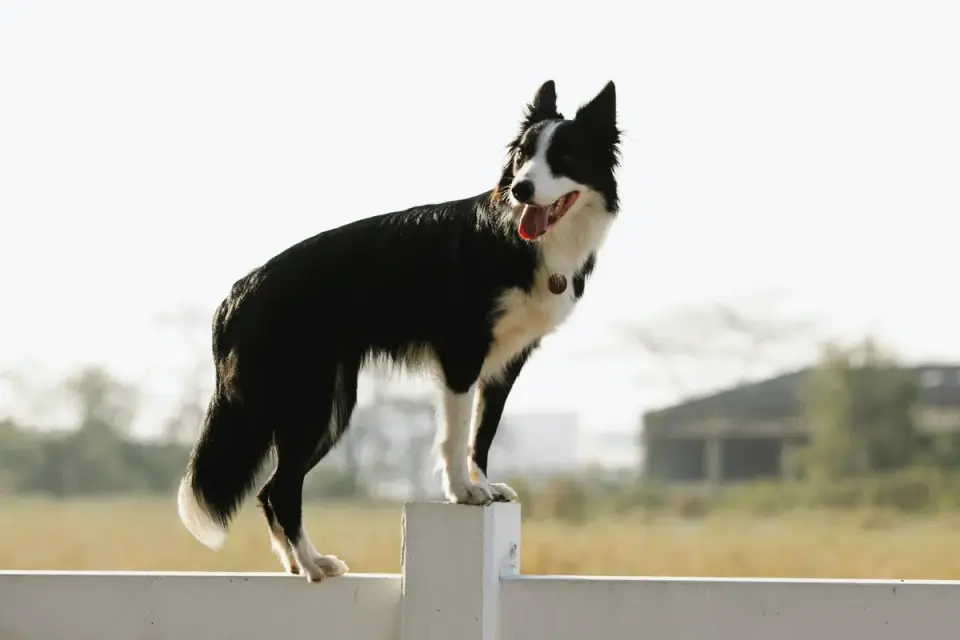
The failed approach I see most is elevation too early. A 4-year-old, 42-pound Border Collie mix came in hopping low cavalettis like agility jumps three weeks in to a home program her owner built from video clips. She cleared them beautifully and got sorer every evening. Height had turned a coordination drill into plyometrics.
We stripped it back to ground poles for two weeks, then raised only alternate ends to 2 inches with cavaletti blocks or soup cans on their sides. Rule: raise no more than 2 inches at a time, never above hock height for rehab dogs, never above mid-cannon for most training dogs. Keep speed at a walk until the dog can do ten consecutive passes with zero knocks.
Use this progression: Weeks 1–2: ground poles, walk, straight line. Weeks 3–4: one end raised 2 inches, walk, add a gentle curve or L-shape. Week 5+: both ends raised symmetrically if the dog stays slow and even, introduce brief trot sets of 3 passes for athletic dogs only.
If fatigue shows as knocking late in a set, lowering the head, or forging ahead, drop height before you drop reps.
Read the feet, then adjust spacing and surface
Cavalettis train active flexion, extension, and timing across all four limbs. Pair that mechanical load with nutritional support that makes physiologic sense. Chondroitin research described in Frontiers in Veterinary Science as work that “supports healthy synovial fluid homeostasis” fits here — you are cycling joints through range under control, and synovial movement is part of that picture. In vitro work summarized in the Journal of Veterinary Medical Science found glucosamine to “prevent experimentally induced cartilage degradation in vitro,” which is laboratory context, not proof of clinical effect in your dog.
Green-lipped mussel adds another ingredient-literate layer: it contains omega-3 fatty acids and glycosaminoglycans studied for joint support, while experimental rodent data in Nutrients reported that “BMO, GMO, and KO all alleviated paw swelling in rats and reduced serum levels of rheumatoid factor (RF), anti-cyclic citrullinated peptide (anti-CCP) antibody, and pro-inflammatory cytokines such as TNF-α and IL-17.” That is preclinical evidence to weigh, not a promise of pain relief.
Keep surfaces grippy. Wet grass, slick floors, and rolling PVC poles cause slips that punish careful dogs. Use flat-sided poles or half-round rails, 1.5–2 inches in diameter, 36–48 inches long.
For context on the rest of the program, I often pair cavalettis with Balance and Proprioception Exercises for Dogs: What Actually Builds Stability early in the week and Core-Strengthening Exercises for Dogs: A Vet Nutritionist’s Practical Guide on alternate days. If you are working post-injury, read At-Home Physical Therapy for Dogs: What It Is and When You Need a Rehab Vet before you progress height.
Know when to stop the session or call the vet
The edge case that changes the plan is the stoic senior who looks better during the set than after it. A 12-year-old, 55-pound Golden Retriever I followed moved beautifully over low poles in the clinic, then lay out flat for hours that night and refused stairs by day 2. Morning-after soreness outranked in-session form.
Use 24-hour feedback as your dose dial. Mild effort is fine; next-day stiffness, reluctance to rise, licking a specific joint, or a new head bob means you overshot volume or height. Cut total passes by half next time and stay on the ground.
Stop and get veterinary assessment for sharp yelps, non-weight-bearing lameness, knuckling, hind-limb crossing that worsens, or back pain signs like a hunched stance or crying when turning. Dogs recovering from IVDD or surgery should only do cavalettis under direct rehab guidance — see Exercise and Rehab Basics After IVDD or a Back Injury.
What would I do if the dog were mine and cleared to train? Two short sessions per week, ten clean walk passes per session, video every second session, and no height chase.
Frequently asked questions
How many cavaletti poles should I start with for my dog?
Start with 4–6 poles on the ground in a straight line, spaced to your dog's natural step. Do 3–5 slow walk passes, rest, then repeat once if form stays clean.
How high should cavaletti poles be?
Start on the ground. Once the dog walks cleanly for ten passes, raise alternate ends about 2 inches. Stay at or below hock height for seniors and rehab cases.
How often can we do cavaletti exercises?
For most adult dogs, 2–3 short sessions per week works well. Use next-morning stiffness as your guide — if the dog is sore, cut volume in half and stay low.
Sources
- Supports healthy synovial fluid homeostasis — Frontiers in Veterinary Science
- Prevent experimentally induced cartilage degradation in vitro — Journal of Veterinary Medical Science
- BMO, GMO, and KO in experimental arthritis — Nutrients