
On this page
Is weekend-only exercise actually bad for a dog’s joints, or is that just something trainers say to sell more walks? I get asked a version of this question almost every week, usually by an owner standing in my exam room holding a dog who was sprinting after a frisbee on Saturday and can barely get up the stairs on Monday.
In my practice, the pattern is almost always the same dog: a five-to-eight-year-old, mixed-breed or Labrador-type, forty to seventy pounds, who spends Monday through Friday napping in an apartment or a fenced yard while the owner works long hours. Then Saturday morning arrives, and that same dog does a six-mile trail hike, or forty minutes of hard fetch at the dog park, or an off-leash sprint session with three other dogs. By Sunday evening, or sometimes not until Monday, the owner calls describing a hind-limb hitch, a reluctance to jump into the car, or a dog who’s suddenly slow going up the stairs he used to take two at a time. The tissue didn’t fail during the hike. It failed from the mismatch between what the muscles, tendons, and cartilage were conditioned to handle and what they were suddenly asked to do.
Why the “weekend warrior” pattern hurts more than steady daily activity
The core issue isn’t exercise, it’s load variance. Tendons, ligaments, and periarticular muscle adapt to whatever stress they’re routinely exposed to, and they de-condition just as reliably when that stress disappears. A dog walked fifteen minutes a day for five days and then asked to cover six miles of uneven trail on day six is being handed a workload his connective tissue hasn’t been trained to absorb. That’s a mechanical problem before it’s ever a nutritional one, and I want to be honest about that boundary: no joint supplement fixes a conditioning gap. What supplements and diet can realistically do is support the tissue environment the dog is already working with — they don’t substitute for a sane loading schedule.
Cartilage itself isn’t a passive shock absorber; it depends on cyclical loading to keep synovial fluid moving nutrients through a mostly avascular tissue. Chondroitin, one of the more studied joint ingredients in dogs, has been shown to support healthy synovial fluid homeostasis, according to a 2026 study in Frontiers in Veterinary Science. That’s relevant here because a joint that’s been under-loaded all week and then overloaded on Saturday is asking synovial fluid turnover to do more work, faster, than it’s used to.
Glucosamine tells a related story. Research reviewed in the Journal of Veterinary Medical Science found that glucosamine HCl can help prevent experimentally induced cartilage degradation in vitro — a lab finding, not a guarantee of clinical outcome in a dog on a trail, but a real signal about what the ingredient is doing at the cartilage level when degradation pressure is present.
What the injury actually looks like in the exam room
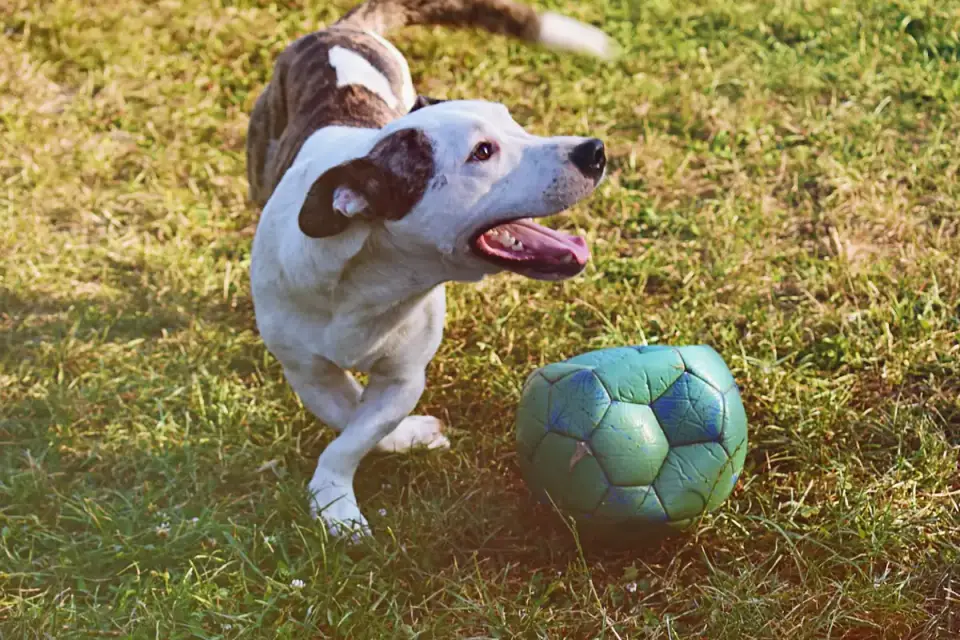
Most of what I see isn’t a torn ligament. It’s soft-tissue strain: iliopsoas soreness, mild hip or stifle effusion, a general stiffness that resolves with rest and returns the next time the dog gets a big activity spike. The owners I see most often describe it the same way — “he was fine Friday, and by Sunday night he just wasn’t himself.” That phrasing matters clinically, because it tells me the injury is load-related, not traumatic. A dog who yelps mid-run has a different problem than a dog who’s quietly stiff two days later.
One dog I worked with, a nine-year-old mixed-breed, sixty-two pounds, had this exact pattern for months before the owner connected the dots: five days of yard time, one long Saturday hike, and a Sunday-through-Tuesday limp that the owner had been treating with rest alone. The fix wasn’t a supplement or a vet visit — it was breaking the six-mile Saturday hike into three shorter outings spread across the week, which changed the loading pattern entirely. That’s one case, not a study, but it’s the pattern I’ve watched repeat across a lot of exam rooms.
Where nutrition and joint support genuinely fit — and where they don’t
Green-lipped mussel is another ingredient worth being specific about rather than vague. In a 2026 study published in Nutrients, green-lipped mussel powder alleviated paw swelling in rats and reduced serum levels of rheumatoid factor, anti-cyclic citrullinated peptide antibody, and pro-inflammatory cytokines including TNF-α and IL-17. That’s rodent inflammatory-arthritis data, not a canine weekend-warrior trial, and I’d rather say that plainly than let the citation imply more than it shows. What it does support is the general mechanism: omega-3s and glycosaminoglycans from green-lipped mussel have a documented anti-inflammatory signature worth weighing when a dog’s joints are under repeated load spikes.
Here’s where I land: a joint supplement is a reasonable piece of a mobility plan for a dog whose owner can’t fully fix the scheduling problem — a working owner who genuinely can’t walk a dog daily but can manage a weekend outing. It is not a substitute for spreading activity out. The strongest counterargument I hear is that supplementation is “cheap insurance” regardless of exercise pattern, and there’s some truth to that for older or arthritic dogs whose joints benefit from consistent support independent of activity level. But for a healthy, younger dog whose only issue is a Monday-through-Friday couch schedule, the fix is behavioral first. If you’re deciding whether your dog’s routine is safe, the more useful question isn’t “does he need a supplement,” it’s “does his week look like five rest days and one hard day.”
If the injury pattern also involves a heart condition, the loading calculus changes further — that’s covered in Can a Dog With a Heart Murmur Exercise? A Vet’s Decision Checklist. Owners looking for a lower-impact way to fill in the missing weekday activity often ask about swimming, which I address in Is Swimming Good Exercise for Dogs? A Vet’s Mechanism-First Look. And once a dog is already sore, a structured home program matters more than another supplement bottle — see At-Home Physical Therapy for Dogs: What It Is and When You Need a Rehab Vet.
Building a week that doesn’t spike the joints
A realistic fix rarely means matching weekend mileage every day. It means shrinking the gap. Three fifteen-minute walks during the week instead of zero, plus a shorter Saturday outing instead of the marathon hike, does more for connective tissue conditioning than any single change on the supplement shelf. For dogs who genuinely can’t get midweek walks, a dog walker, a midday yard session, or even structured indoor fetch in a hallway closes some of that gap.
Building stability matters too, since dogs whose proprioception is already compromised — through age, prior injury, or breed conformation — are more vulnerable to a sudden load spike. That’s covered in more depth in Balance and Proprioception Exercises for Dogs: What Actually Builds Stability.
To recap: weekend warrior syndrome isn’t about the weekend hike being inherently bad. It’s about the five quiet days before it. Match the loading pattern to the tissue’s actual conditioning, use joint-support ingredients like chondroitin, glucosamine, and green-lipped mussel where the evidence genuinely applies, and treat supplementation as one part of a mobility plan rather than the fix for a scheduling problem.
Frequently asked questions
Is it bad to only exercise my dog on weekends?
A big activity spike after five sedentary days is a common source of soft-tissue soreness and joint strain, even though occasional hard hikes aren't inherently dangerous. The risk comes from the mismatch, not the hike itself.
How do I know if my dog is sore from a weekend hike versus something more serious?
Mild stiffness or reluctance to jump that shows up a day or two after activity and improves with rest is usually load-related soreness. A sudden yelp, non-weight-bearing lameness, or swelling that doesn't improve warrants a vet visit.
Sources
- Chondroitin sulfate and synovial fluid homeostasis — Frontiers in Veterinary Science
- Glucosamine HCl and cartilage degradation — Journal of Veterinary Medical Science
- Green-lipped mussel powder and inflammatory markers — Nutrients